




Protein vs. Peptide Antigens: Advantages and Disadvantages
Table of Contents
When antibodies fail, the root cause is often planted long before it is noticed. In the vast majority of cases, this vulnerability originates at the antigen selection stage. Choosing between a recombinant full-length protein and a synthetic peptide as the immunogen is far from a trivial technical detail—it directly determines the epitope type recognized by the antibody (linear versus conformational), conformational dependency, detection specificity, applicable sample types, validation difficulty, and ultimately the credibility of the research findings.
In real-world laboratory settings, researchers rarely engage in abstract debates over “protein versus peptide” as an upstream decision. Their entry point is always downstream validation scenarios: Can this antibody recognize native proteins in tissue sections subjected to fixation and embedding? Can it distinguish between highly homologous isoforms or splice variants? Can it be detected under denaturing conditions in Western blot, or capture functionally active proteins with native conformations in immunoprecipitation? Can it precisely identify phosphorylation at a specific site without interference from neighboring phosphorylation sites on the same protein? Can it withstand rigorous validation using knockout cell lines or mutants? The answers to these core questions ultimately point to an upstream technical choice: protein antigen, or peptide antigen.In this field, Beijing Solarbio Science & Technology Co., Ltd. has built a comprehensive life science reagent platform covering antibodies, peptides, recombinant proteins, ELISA kits, staining solutions, biochemical kits, and molecular biology reagents. For researchers who prefer integrated antigen design, antibody development, and validation services, such a structured platform reduces coordination risk and shortens timelines.
What Is An Immunogen?
An immunogen is a substance that induces adaptive immune responses and produces specific antibodies. Solarbio CRO services offer two immunogen strategies:
Synthetic peptide antigen: A short sequence (15-25 amino acids) conjugated to carrier proteins (e.g., KLH) for enhanced immunogenicity. It enables precise targeting of specific sequences, post-translational modifications, and distinction of highly homologous isoforms or splice variants.
Recombinant full-length protein antigen: Retains native folding and carries both linear and conformational epitopes, suitable for applications requiring native conformation recognition, such as non-denaturing immunoprecipitation, functional blocking, or active protein capture.
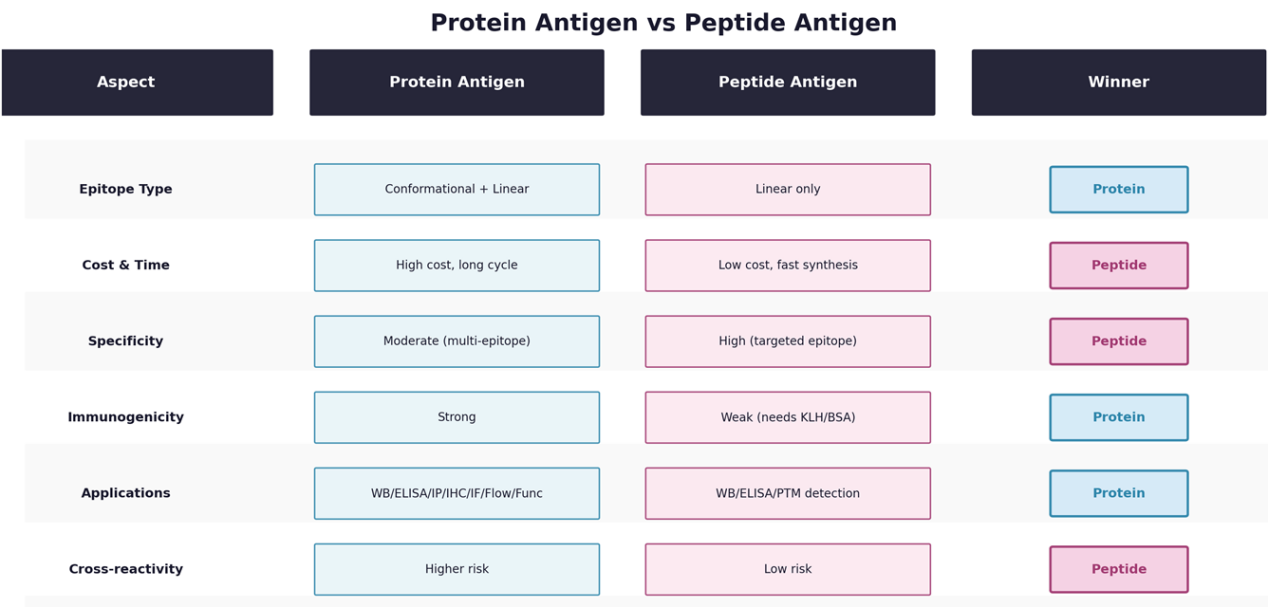
The key difference lies in epitope presentation: peptides primarily contain linear epitopes, while full-length proteins contain both linear and conformational epitopes. This defines application boundaries—peptide-derived antibodies typically suit denaturing or fixed conditions (Western blot, IHC-P), whereas protein antigens serve conformation-dependent applications..
What Are The Advantages And Disadvantages Of Peptide Antigens?
Peptide antigens are chemically synthesized short amino acid sequences that can precisely carry specific modifications such as phosphorylation and acetylation. Their core advantage lies in precise targeting—capable of distinguishing highly homologous protein isoforms and enabling site-specific recognition of post-translational modifications, with short synthesis cycles and controllable purity. Limitations are equally significant: peptides cannot mimic native protein conformations, making them unsuitable for conformation-dependent applications such as immunoprecipitation or functional blocking assays. Their immunogenicity is relatively weak, requiring conjugation to carrier proteins for effective antibody induction, and some sequences may yield low-affinity antibodies due to unfavorable physicochemical properties. Therefore, peptide antigens are suitable for linear epitope applications including Western blot, modification detection, and isoform discrimination, while conformation-dependent applications require full-length protein antigens.
What Are The Advantages And Disadvantages Of Protein Antigens?
Protein antigens are full-length proteins or functional domains produced via recombinant expression systems (E. coli, yeast, insect, or mammalian cells).
Advantages: Comprehensive epitope coverage—full-length proteins carry both linear and conformational epitopes, enabling polyclonal antibody production with broad platform applicability (WB, IP, IHC, IF, flow cytometry). Critical for conformation-dependent applications such as native immunoprecipitation, functional blocking, and ligand-receptor studies.
Limitations: Complex preparation—membrane, toxic, or hydrophobic proteins are difficult to express and purify. Batch-to-batch variation in post-translational modifications can lead to inconsistent antibody performance..
Beijing Solarbio Science & Technology Co., Ltd. makes over 1,000 new proteins each year. It helps with gene synthesis, vector building, expression checks, purification, and detail analysis. These joined processes lower changes and give key points during the work.
When Should A Peptide Antigen Be Chosen?
Peptide antigens are preferred when precise targeting of a specific sequence region is required.
Isoform discrimination: Selecting peptide sequences targeting differential regions enables specific recognition of highly homologous protein isoforms or splice variants.
Post-translational modification detection: Synthetic peptides carrying precise modifications (phosphorylation, methylation, acetylation) accurately mimic the target epitope—essential for signaling pathway research involving HIF, TNF, PI3K, and similar targets.
Technical feasibility: When target proteins are too large, difficult to express, or challenging to purify, peptide synthesis reduces preparation costs and shortens development timelines.
When Should A Protein Antigen Be Chosen?
Protein antigens are preferred when broader application compatibility is needed.
For experiments involving immunoprecipitation (IP), immunofluorescence (IF), flow cytometry, or functional blocking assays that depend on native protein conformation, full-length protein immunogens induce conformation-specific antibodies, significantly improving experimental success rates.
When the goal is broad detection of total target protein levels across tissues, cell lines, or species, protein antigen-induced polyclonal antibodies covering multiple epitopes offer greater detection flexibility and cross-sample compatibility.
For target proteins with complex post-translational modifications (e.g., glycosylation, multi-subunit assembly) where modification state is critical for antibody recognition, mammalian cell-expressed recombinant proteins more closely approximate native modification patterns.
For labs needing supplies that can grow, quality management systems count too. A set QMS based on planning, oversight, checking, and bettering cycles backs steady work from plan to handover. Beijing Solarbio Science & Technology Co., Ltd. works under these standard setups. They include product growth, quality tests, storage, and moving goods over several centers.
How Does Antigen Choice Affect Downstream Applications?
Antigen selection directly impacts validation strategies, experimental design, and result stability.
In ELISA, linear epitope recognition suffices, as coating changes antigen conformation. For IP, co-localization, or protein interaction studies, native conformation recognition is essential.
For high-impact publication, reviewers require multi-platform validation (WB, IP, IHC, IF). Peptide antigens often fail conformation-dependent tests; protein antigens offer broader applicability but risk non-specific binding. Matching immunogen design to application is critical for reproducibility.
Antigen selection also affects long-term costs. Antibody failure triggers repeated preparation, extra validation, and delays—expenses that far exceed initial preparation costs. Prudent upfront selection based on downstream requirements effectively mitigates these risks..
FAQ
Q1: Is a protein antigen always better than a peptide antigen?
A: Not necessarily. The optimal choice depends on the specific application: peptide antigens offer greater advantages when precise sequence control is required—for distinguishing highly homologous isoforms or splice variants, or for detecting specific post-translational modifications such as phosphorylation and methylation—whereas protein antigens, with their broad epitope coverage, are more suitable for applications demanding cross-platform versatility across WB, IP, IF, and IHC, or those dependent on native conformation recognition..
Q2: Can peptide-derived antibodies recognize native protein structures?
A: Peptide-derived antibodies may recognize native protein structures only if the target sequence is surface-exposed; they fail against buried sequences or conformational epitopes. Sample processing (fixation, embedding) can also alter epitope accessibility.
Q3: Are protein antigens more difficult to produce?
A: Yes. Recombinant protein expression involves gene synthesis, vector construction, system selection, solubility optimization, purification, and quality control. Membrane proteins, toxic proteins, and highly hydrophobic proteins often show low expression, form inclusion bodies, or misfold—significantly higher technical barriers than peptide synthesis..
Q4: How can cross-reactivity be minimized?
A: For peptides, selecting unique sequences reduces cross-reaction risk. For proteins, rigorous screening and validation across multiple applications are essential.
Q5: How can I ensure consistent results when using reagents from different batches?
A: Solarbio implements strict ISO 9001 quality control systems to minimize variability across batches. Every batch comes with a COA (Certificate of Analysis), ensuring consistency and traceability for every reagent used in your experiments.
Q6: How do I know if the antibodies I am using are specific to my target?
A: To ensure antibody specificity, Solarbio provides detailed validation services, including cross-reactivity tests and multiple method validations (Western Blot, IHC). We also offer antibody customization based on your specific needs for higher accuracy.
Q7: What should I do if my antibodies fail to recognize the target protein in tissue samples?
A: This issue is mainly caused by epitope masking or protein conformational changes during tissue processing. You can first verify the antibody validity through WB, IF and flow cytometry, and then optimize antigen retrieval conditions including buffer pH, temperature and reaction time. If the problem remains unsolved, you may redesign the immunogen by switching between peptide and full-length protein, or perform epitope mapping to identify the binding region for targeted optimization.
| Cat | product name | Titleoftheliterature | IF |
| P02346 | Recombinant human HSP70 protein | Glucosidase alpha neutral C promotes influenza virus replication by inhibiting proteosome-dependent degradation of hemagglutinin | 53 |
| P02346 | Recombinant human HSP70 protein | Glucosidase alpha neutral C promotes influenza virus replication by inhibiting proteosome-dependent degradation of hemagglutinin | 53 |
| P02467 | Recombinant human DNAJB1 protein | Glucosidase alpha neutral C promotes influenza virus replication by inhibiting proteosome-dependent degradation of hemagglutinin | 53 |
| P02467 | Recombinant human DNAJB1 protein | Glucosidase alpha neutral C promotes influenza virus replication by inhibiting proteosome-dependent degradation of hemagglutinin | 53 |
| P04721 | Recombinant human SET protein | GZMK-expressing CD8+ T cells promote recurrent airway inflammatory diseases | 51 |
| P02695 | Recombinant human SET protein | GZMK-expressing CD8+ T cells promote recurrent airway inflammatory diseases | 51 |
| P08361 | Recombinant human CD19 protein | Ferritin aggregation cell engager for CAR T avidity engineering against refractory leukemias | 43 |
| CLP0080 | OVA Peptide (257-264) | Meningeal blood vessel blockage enhances anti-glioblastoma immunity | 43 |
| P05798 | Recombinant human TFRC protein | Ferritin aggregation cell engager for CAR T avidity engineering against refractory leukemias | 43 |
| CLP0705 | OVA (257-264),amide | Reversal of tumour immune evasion via enhanced MHC-Class-I antigen presentation by a dual-functional RNA regulated system | 34 |
| CLP0705 | OVA (257-264),amide | Reversal of tumour immune evasion via enhanced MHC-Class-I antigen presentation by a dual-functional RNA regulated system | 34 |
| P00021 | Recombinant Human IL-4 (E. coli) | Reshaping the Endogenous Electric Field to Boost Wound Repair via Electrogenerative Dressing | 29 |
| P00133 | Recombinant Human IL-4 | Drug-Loaded Bacillus Calmette–Guérin Bacteria for Immuno-Chemo Combo Therapy in Bladder Cancer | 29 |
| P00184 | Recombinant Mouse GM-CSF (C-6His) | Drug-Loaded Bacillus Calmette–Guérin Bacteria for Immuno-Chemo Combo Therapy in Bladder Cancer | 29 |
| P00196 | Recombinant Mouse IL-4 | Drug-Loaded Bacillus Calmette–Guérin Bacteria for Immuno-Chemo Combo Therapy in Bladder Cancer | 29 |
| P02755 | Recombinant human PLAU protein | Outer Membrane Vesicle-Based Nanohybrids Target Tumor-Associated Macrophages to Enhance Trained Immunity-Related Vaccine-Generated Antitumor Activity | 29 |
| P00114 | Recombinant Mouse Beta-NGF (110AA) | Exosome-loaded degradable polymeric microcapsules for the treatment of vitreoretinal diseases | 28 |
| P08114 | Recombinant BFP protein | Delaying pyroptosis with an AI-screened gasdermin D pore blocker mitigates inflammatory response | 28 |
| CLP0114 | Laminin(929-933) | Nanofibrous Guidance Conduits with Multiple Gradient Cues for Spinal Cord Repair | 27 |
| CLP0107 | Laminin(925-933) | Nanofibrous Guidance Conduits with Multiple Gradient Cues for Spinal Cord Repair | 27 |
| CLP0109 | Laminin(929-933),amide | Nanofibrous Guidance Conduits with Multiple Gradient Cues for Spinal Cord Repair | 27 |
| CLP0667 | Laminin(925-933),amide | Nanofibrous Guidance Conduits with Multiple Gradient Cues for Spinal Cord Repair | 27 |
| CLP0797 | Lysozyme | Personalized Cancer Immunotherapy Boosted by cGAS-STING-Targeted Nanovaccines in Combination With Nutrient Modulation | 23 |
| CLP0797 | Lysozyme | Personalized Cancer Immunotherapy Boosted by cGAS-STING-Targeted Nanovaccines in Combination With Nutrient Modulation | 23 |
| P02149 | Recombinant Human/Mouse/Rat TGFB3 | Immunoregulatory Nanofiber Patches with Locally Activated Delivery of ECM-Producing Drugs Improve Repair in an Intervertebral Disc Herniation Model | 21 |
| P03581 | Recombinant human ARF4 protein | ARF4-mediated intracellular transport as a broad-spectrum antiviral target | 21 |
| P00209 | Recombinant Mouse IFN alpha2 | An erythroid-biased FOShi hematopoietic multipotent progenitor subpopulation contributes to adaptation to chronic hypoxia | 20 |
| P00794 | Recombinant Human OLR1 (C-6His) | An MSR1-Targeting Glycolipid Platform for Imaging the Changes of Phagocytic Macrophages in the Progression of Atherosclerotic Plaque | 19 |
| P00794 | Recombinant Human OLR1 (C-6His) | An MSR1-Targeting Glycolipid Platform for Imaging the Changes of Phagocytic Macrophages in the Progression of Atherosclerotic Plaque | 19 |
| P00199 | Recombinant Mouse/Rat TGF-beta 1 | Hyperbaric oxygen regulates tumor mechanics and augments Abraxane and gemcitabine antitumor effects against pancreatic ductal adenocarcinoma by inhibiting cancer-associated fibroblasts | 19 |
| P00199 | Recombinant Mouse/Rat TGF-beta 1 | Hyperbaric oxygen regulates tumor mechanics and augments Abraxane and gemcitabine antitumor effects against pancreatic ductal adenocarcinoma by inhibiting cancer-associated fibroblasts | 19 |
| P00033 | Recombinant Human EGF | Axon-like aligned conductive CNT/GelMA hydrogel fibers combined with electrical stimulation for spinal cord injury recovery | 19 |
| P00033 | Recombinant Human EGF | 3D bio-printed living nerve-like fibers refine the ecological niche for long-distance spinal cord injury regeneration | 19 |
| P00165 | Recombinant Mouse EGF (C-6His) | Axon-like aligned conductive CNT/GelMA hydrogel fibers combined with electrical stimulation for spinal cord injury recovery | 19 |
| CLP0338 | bFGF (119-126) | Axon-like aligned conductive CNT/GelMA hydrogel fibers combined with electrical stimulation for spinal cord injury recovery | 19 |
| CLP0797 | Lysozyme | A suture-free,shape self-adaptive and bioactive PEG-Lysozyme implant for Corneal stroma defect repair and rapid vision restoration | 19 |
| P00513 | Recombinant Mouse FGFb | 3D bio-printed living nerve-like fibers refine the ecological niche for long-distance spinal cord injury regeneration | 19 |
| P02067 | Recombinant Mouse RANK L (N-6His) | A parathyroid hormone related supramolecular peptide for multi-functionalized osteoregeneration | 19 |
| P02149 | Recombinant Human/Mouse/Rat TGFB3 | Enhanced bone regeneration via endochondral ossification using Exendin-4-modified mesenchymal stem cells | 19 |
| P03659 | Recombinant human IL1B protein | Enhanced bone regeneration via endochondral ossification using Exendin-4-modified mesenchymal stem cells | 19 |
| P00080 | Recombinant Human MMP-2 (C-6His) | In vivo self-assembled bispecific fluorescence probe for early detection of bladder cancer and metastasis | 19 |
| P00028 | Recombinant Human IFN gamma | Design of Diselenide-Bridged Hyaluronic Acid Nano-antioxidant for Efficient ROS Scavenging to Relieve Colitis | 18 |
| CLP0253 | Ovalbumin (154-159) | Superiorly Stable Three-Layer Air Microbubbles Generated by Versatile Ethanol–Water Exchange for Contrast-Enhanced Ultrasound Theranostics | 18 |
| P00063 | Recombinant Human VEGF165 | A ceramic microbridge microfluidic chip to study osteogenic differentiation of mesenchymal stem cells in bioactive ceramic immune microenvironment | 18 |
| CLP0797 | Lysozyme | Injectable immunoregulatory hydrogels sequentially drive phenotypic polarization of macrophages for infected wound healing | 18 |
| CLP0797 | Lysozyme | cAMP and c-di-GMP synergistically support biofilm maintenance through the direct interaction of their effectors | 18 |
| P00794 | Recombinant Human OLR1 (C-6His) | Extracellular traps from activated vascular smooth muscle cells drive the progression of atherosclerosis | 18 |
| CLP0037 | GRGDSPC | Smart battery-free and wireless bioelectronic platform based on a nature-skin-derived organohydrogel for chronic wound diagnosis, assessment, and accelerated healing | 18 |
| CLP0037 | GRGDSPC | Smart battery-free and wireless bioelectronic platform based on a nature-skin-derived organohydrogel for chronic wound diagnosis, assessment, and accelerated healing | 18 |
 Consult
 Whatsapp
 Leave Message
 top
top