


Recombinant M-CSF/CSF-1 in Colony Stimulating Factor (CSF) Protein Research: What It Actually Does
Tabla de Contenidos
Blood cells lean on colony stimulating factors (CSFs) to grow, develop, and stay alive. Without them acting on hematopoietic stem cells, whole immune cell populations simply wouldn’t take shape. Three members hog the traffic in myeloid work, and their names are M-CSF, GM-CSF and G-CSF.
Macrophage colony-stimulating factor (M-CSF) is the one we hear argued about most. You’ll see it printed as CSF-1 in plenty of papers — same protein, either way you read it. Where it matters? Monocytes, macrophages, osteoclasts. Macrophage survival runs on it, differentiation gets pushed by it, and inflammatory responses plus tissue repair wouldn’t work the same without it.
Stay in immunology, hematopoiesis, bone metabolism, or tumor biology long enough and recombinant CSF proteins come find you anyway. Controlled experimental conditions leave nobody a realistic substitute.
Solarbio offers recombinant mouse and human M-CSF/CSF-1 proteins inside its protein product portfolio. This piece walks through the biology behind the two products, how Solarbio characterizes them, where labs put them to work, and what the quality data actually shows.
1. Colony Stimulating Factors (CSFs), Without the Textbook
Call a colony stimulating factor what it is: a hematopoietic growth factor, and the group collectively runs how blood cells get produced and developed. Cell proliferation sits under their influence, so does differentiation, so does survival and functional activity.
Most study groups stick to three members — M-CSF, GM-CSF, G-CSF. One general family of hematopoietic regulators, honestly, yet each works different target cells and each does a different job.
M-CSF (Macrophage Colony-Stimulating Factor)
CSF-1, that’s the other name for M-CSF. The monocyte-macrophage lineage is its home turf. Monocytes hang on longer when it’s around, they multiply, and it promotes their differentiation into macrophages along the way.
Osteoclasts make up the other big story here. Bone resorption is the osteoclast’s job, which means any lab watching bone metabolism, or inflammatory bone disease for that matter, ends up citing M-CSF sooner or later.
GM-CSF (Granulocyte-Macrophage Colony-Stimulating Factor)
With GM-CSF’s support, granulocytes and macrophages develop and activate. Its reach extends into several other immune cell populations as well — that’s why inflammatory response and immune regulation studies keep it on the bench.
G-CSF (Granulocyte Colony-Stimulating Factor)
G-CSF’s business is neutrophils. Production first, maturation after. Granulocyte precursors proliferate and differentiate under its push, and any hematopoiesis or neutrophil biology paper you crack open will have it in the citations.
2. M-CSF/CSF-1: What It’s Built Like and How It Signals
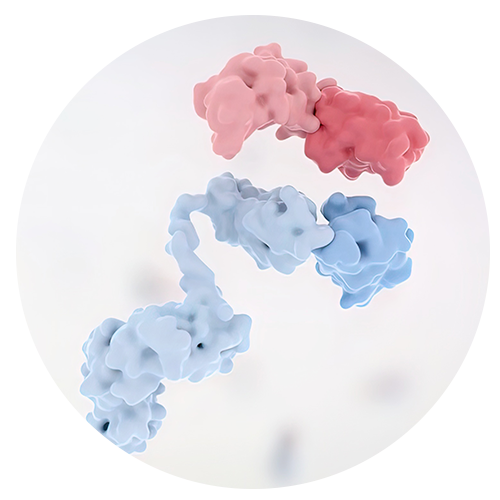
A secreted glycoprotein, M-CSF, of the hematopoietic growth factor family. As for what’s biologically active: generally a disulfide-linked homodimer.
Fibroblasts make it. So do endothelial cells, macrophages, osteoblasts. The protein gets released into the extracellular environment from there and finds its specific receptor on the target cell.
What Happens the Moment M-CSF Meets CSF1R
The main receptor goes by CSF1R. Open older literature and it’s c-Fms. It belongs to the receptor tyrosine kinase family.
M-CSF binds. The receptors come together, dimerization and autophosphorylation follow one after another. Downstream you get signaling through PI3K/AKT, Ras/MAPK, and JAK/STAT-related pathways.
And what are these pathways doing all day? Running cell survival, proliferation, differentiation, and functional activity.
Researchers studying these mechanisms can explore Solarbio’s growth factor research solutions.
3. Key Biological Functions of M-CSF
M-CSF touches a lot of physiology. Its effects are not limited to blood cell development, which explains the spread of research areas that use it.
Building Macrophages, Then Keeping Them
Regulating monocyte and macrophage development is the core job, full stop.
Monocytes survive longer with M-CSF in the mix and mature into macrophages under its influence. Tissue by tissue, the macrophage populations there keep themselves going with the same protein.
Which is why an innate immunity lab nearly always has M-CSF on the bench — macrophage differentiation work, cell survival, macrophage-related signaling, all of it.
Osteoclasts and Bone Metabolism
Osteoclast precursors need M-CSF, both to survive and to proliferate. Then add RANKL, and the pair carries osteoclast differentiation and maturation through.
Bone remodeling work cites that pairing constantly. So does osteoporosis, rheumatoid arthritis, and the pile of other conditions where bone resorption goes abnormal.
Inflammation, and the Repair Afterward
Part of inflammation and tissue repair runs through M-CSF too, though people talk about it less.
Tissue gets injured, macrophages move in — clearing damaged cells, helping regulate the inflammation, staying for the recovery. Somebody has to keep those macrophage populations supplied, and that somebody is M-CSF.
Tumor Microenvironment Work
Here’s something that surprised people a decade ago: tumors recruit macrophages, and it matters an uncomfortable amount. Tumor-associated macrophages (TAMs) can influence tumor growth, angiogenesis, immune suppression, metastasis.
Inside tumors, macrophage recruitment, survival, and functional regulation all pull in M-CSF/CSF1R signaling somewhere. Cancer immunology and drug development have watched this pathway closely for years, and they aren’t finished.
4. The Solarbio Recombinant M-CSF/CSF-1 Products
Both mouse and human sources are covered; Solarbio provides recombinant M-CSF/CSF-1 proteins from either. Hematopoietic development, macrophage biology, immune regulation: the products are designed for research applications in these areas.
P36024ME: ActivAb® Recombinant Mouse M-CSF/CSF-1 Protein, Tag Free
Product name: ActivAb® Recombinant Mouse M-CSF/CSF-1 Protein, Tag free
Catalog number: P36024ME
Mouse M-CSF/CSF-1 shows up constantly in studies of monocyte and macrophage development. Research on osteoclast differentiation, inflammatory diseases, and mouse disease models draws on it too.
This recombinant protein suits work on the biological activity of mouse M-CSF and its interaction with the CSF1R signaling pathway.
Product information sits in the Catálogo de productos de Solarbio under catalog number P36024ME.
P36040HE: ActivAb® Recombinant Human M-CSF/CSF-1 Protein, Tag Free
Product name: ActivAb® Recombinant Human M-CSF/CSF-1 Protein, Tag free
Catalog number: P36040HE
Human monocyte and macrophage biology is what human M-CSF/CSF-1 is made for.
Innate immunity, inflammatory signaling, macrophage differentiation show up most. Tumor-associated macrophages and cardiovascular disease mechanisms too.
On experiments using human cell models, this is the species-matched recombinant protein option.
The catalog entry is found by searching P36040HE at Solarbio.
Product Quality and Performance
Cell-based experiments punish sloppy protein. Differences in purity, protein structure, and biological activity all leak into your results.
Solarbio’s recombinant M-CSF products focus on protein purification, batch consistency, low endotoxin levels, and biological activity.
The proteins are also evaluated for cell-based biological activity, protein conformation, and homogeneity.
For more information about Solarbio’s company background, visit the Solarbio About Us page.
5. Recombinant M-CSF Protein Activity and Purity Data
Activity and purity are the two factors that decide a recombinant cytokine purchase. A clear band on an electrophoresis gel proves the sample contains the protein; it proves nothing about whether cells will respond. Cell-based assays close that gap.
Cell-Based Bioactivity Assay: ED50 of 3–15 ng/mL
The M-NFS-60 assay is the standard route here, using M-NFS-60 mouse myelogenous leukemia lymphoblast cells in a cell proliferation assay.
Biologically active M-CSF gets a response out of the cells; inactive protein doesn’t. Detect the OD450 signal and proliferation is measured. Plot that against concentration and the curve shows what the recombinant protein is worth, activity-wise.
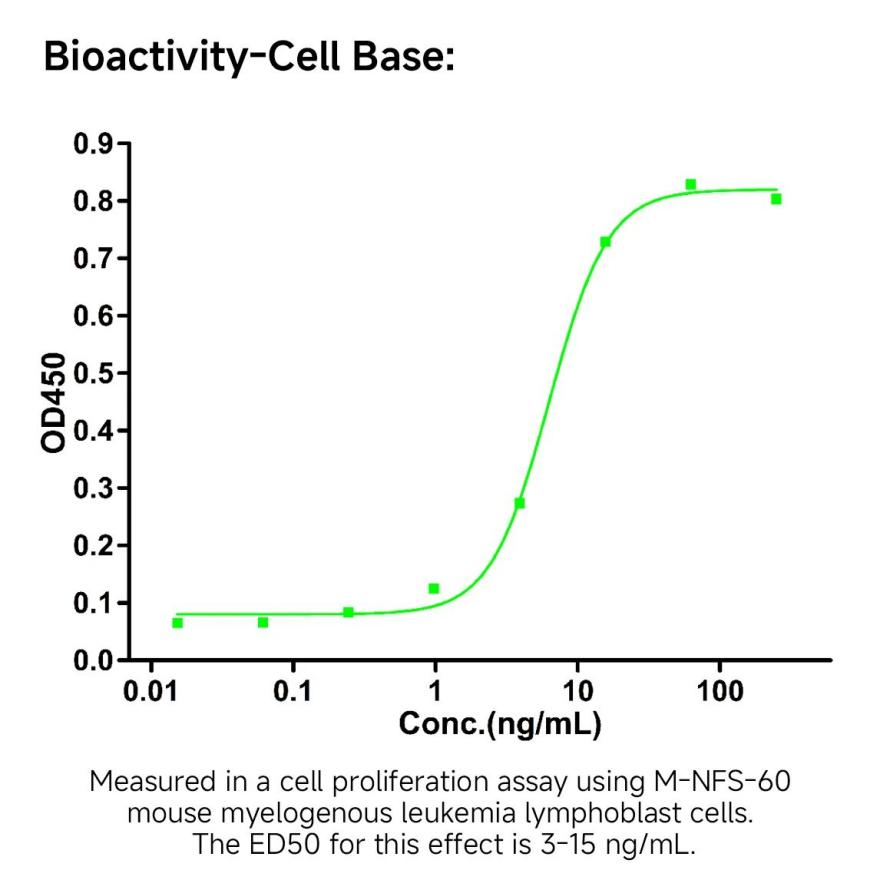
M-CSF concentration climbs, so does cell proliferation. Push past a certain point and the response reaches a plateau — anyone who has run a concentration-dependent cell proliferation assay expects that shape.
Checking Purity on SDS-PAGE
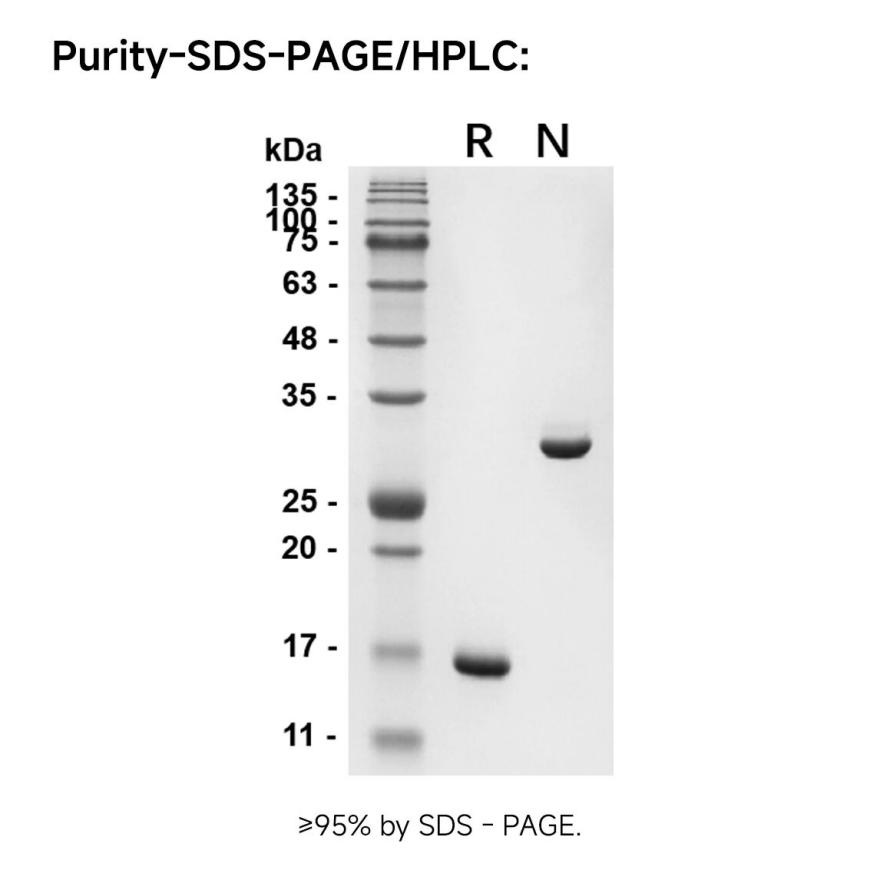
Purity is the other number buyers ask about first. Run an SDS-PAGE: the band pattern will show you major impurities, unexpected protein fragments, whatever’s actually in the tube.
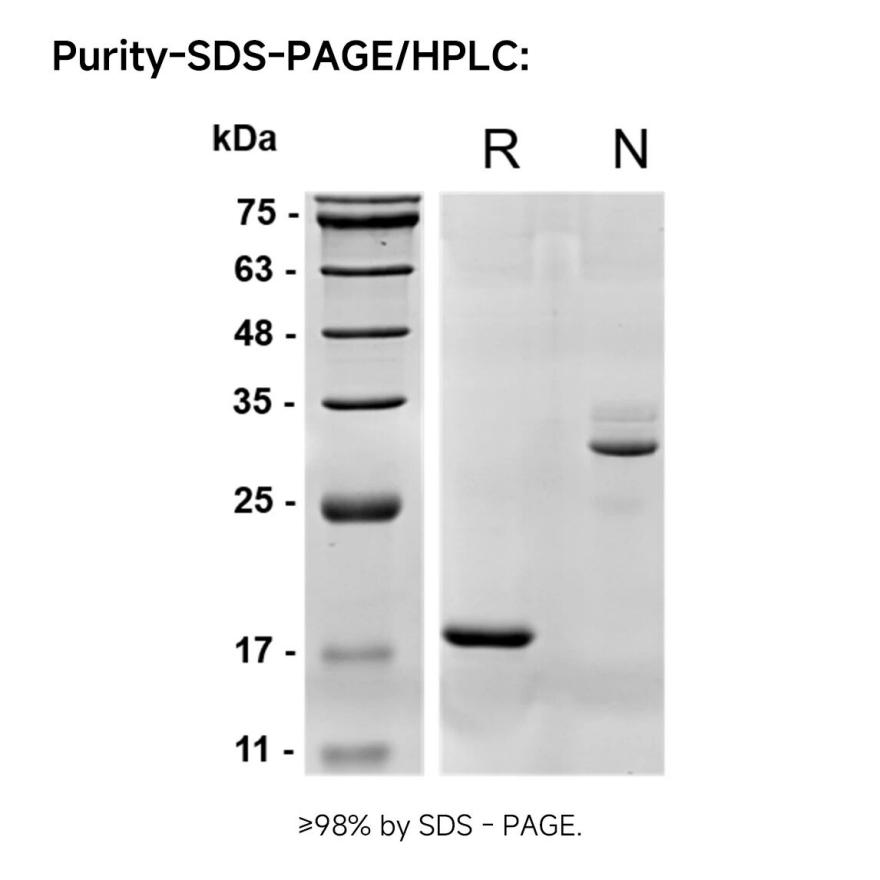
The displayed result puts purity at least 98%. As a read on electrophoretic profile and overall sample quality, that’s a fair reference.
Additional Cell-Based Bioactivity Result: ED50 of 9 ng/mL
A second cell-based activity result exists on the same M-NFS-60 cell model.
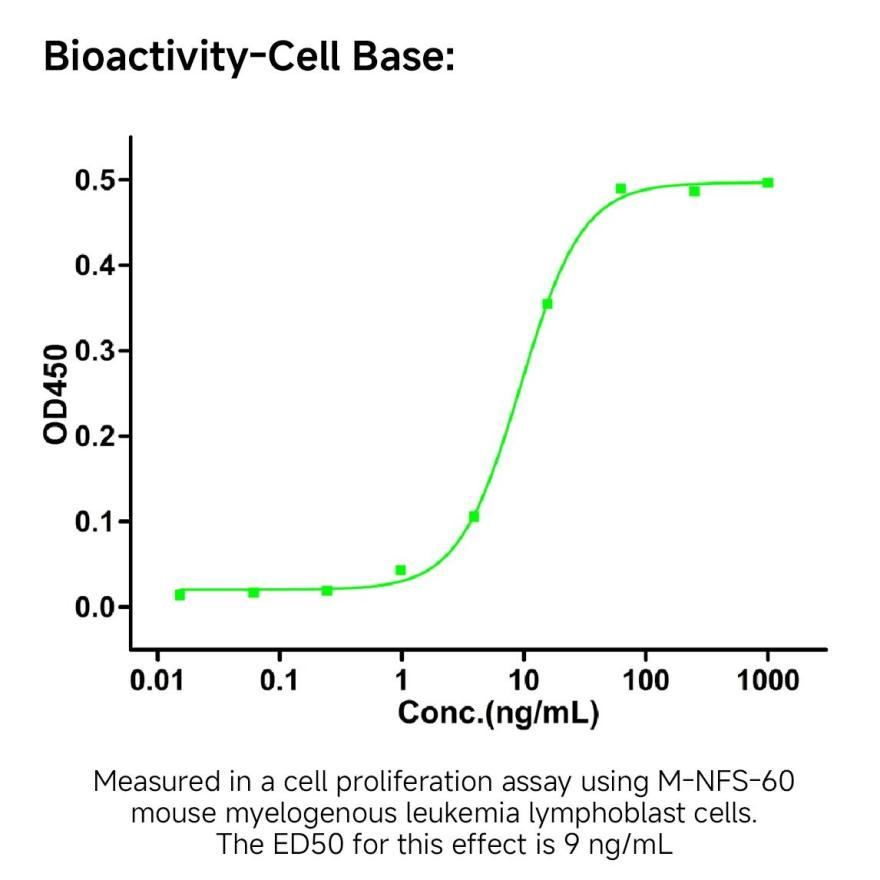
That run comes back with an ED50 of 9 ng/mL. Don’t forget an ED50 only means something standing next to its assay conditions, its cell model, and the product-specific testing protocol behind it.
More Characterization Data
Beyond activity and purity, characterization data is what closes out a quality assessment of recombinant M-CSF.
6. Where Researchers Actually Use M-CSF Proteins
Where recombinant M-CSF gets used depends on the cell model and the experimental objective.
Macrophage Differentiation, the Standard Experiment
Monocyte-to-macrophage differentiation is the classic. What you follow through the process: cell morphology, surface markers, gene expression, and what the finished macrophages can actually do.
Take BMDMs. Mouse bone marrow-derived macrophages get generated with M-CSF under suitable culture conditions, and it’s done in labs everywhere.
Anyone working with macrophage models may also want the related piece on RAW264.7 M1 Macrophage Polarization and Phenotype Validation.
Inflammatory Disease Models
During inflammation, macrophage regulation involves M-CSF/CSF1R signaling. That’s the reason recombinant M-CSF turns up in model work on rheumatoid arthritis, atherosclerosis, and other inflammatory conditions.
Tumor Immunology Benches
Tumor-associated macrophage research burns through a lot of this protein. Most labs chase one question: what does CSF1R signaling do to macrophage survival, recruitment, and functional characteristics inside a tumor model?
Bone Biology Labs
Bone remodeling and osteoclast activity studies use M-CSF directly, since osteoclast precursor survival and differentiation depend on it.
Combine it with RANKL in an appropriate cell culture system and osteoclast formation opens right up for study, along with the bone resorption mechanisms wrapped around it.
7. How to Select the Right M-CSF Protein for Your Experiment
Mouse or human is the first fork in the road.
Mouse macrophages, mouse bone marrow cells, mouse disease models — any of these points you toward P36024ME as the species-matched option.
Human monocytes, human macrophages, other human cell models: that’s the P36040HE case.
Before anything reaches the incubator, check species compatibility. Similar biological functions don’t guarantee identical behavior across species on activity or receptor interactions, so nobody should assume.
The rest of the checklist: cell type, experimental purpose, protein concentration, culture conditions, recommended storage conditions.
Solarbio keeps information up on related biological pathways and servicios técnicos for anyone who wants further research guidance.
Conclusión
Colony stimulating factors run hematopoiesis and immune cell development from the top of the ladder. Mid-ladder sits M-CSF/CSF-1: monocyte survival, macrophage differentiation, osteoclast development, inflammation, tumor microenvironment regulation.
Solarbio keeps two species-specific options in the catalog, ActivAb® Recombinant Mouse M-CSF/CSF-1 Protein, Tag free (P36024ME) and ActivAb® Recombinant Human M-CSF/CSF-1 Protein, Tag free (P36040HE). Macrophage biology and its neighboring fields are exactly who they’re for.
You can weigh a product before buying it, and the cell-based bioactivity data plus the SDS-PAGE purity results are what make that possible. Species compatibility, biological activity, purity, and your experimental model’s requirements are the four things to line up.
Product specifications, technical questions, purchasing help — Solarbio takes those through its normal contact channels.
Preguntas frecuentes
Q1: So what exactly is M-CSF (CSF-1)?
A1: A hematopoietic growth factor going by CSF-1 as its other name. Under its regulation, monocytes and macrophages survive, proliferate, and differentiate. Osteoclast development leans on it too.
Q2: M-CSF, GM-CSF, G-CSF — what separates the three?
A2: They run different branches of one blood-cell family. The monocyte-macrophage lineage is M-CSF’s, mainly. Granulocyte and macrophage development gets supported by GM-CSF. Neutrophil production and maturation is where G-CSF mostly works.
Q3: Which receptor does M-CSF actually bind?
A3: CSF1R — a receptor tyrosine kinase, known in older papers as c-Fms. Once that interaction happens, downstream signaling switches on: the pathways behind cell survival, proliferation, differentiation.
Q4: So what’s different between mouse M-CSF and human M-CSF?
A4: Different systems, short answer. Mouse biological systems get mouse M-CSF; human cell models get the human one. Buy the species-matched protein, and if you’re tempted to run either in a different species, confirm cross-reactivity before wasting the sample.
Q5: What role does M-CSF play in macrophage differentiation?
A5: It keeps monocytes alive and drives them into macrophages. Macrophage culture and differentiation studies use it constantly — generating bone marrow-derived macrophages being the routine example.
Q6: Why should osteoclast research care about M-CSF?
A6: Osteoclast precursors need it just to survive and proliferate. With RANKL alongside, it helps promote differentiation and maturation from there. Bone metabolism research ends up useful for it, unsurprisingly.
 Consultar
 Aplicación Whatsapp
 Dejar mensaje
 arriba