



Chlorogenic Acid: Structure, Isomers, Stability, Extraction, and Preparation
Table of Contents
Chlorogenic acid is a naturally occurring small molecule found in plants and has received considerable interest in recent years from researchers in the areas of natural products chemistry and biology. It is a major bioactive component found in the honeysuckle plant and has been reported to display antibacterial and antiviral activities. More recently, chlorogenic acid has been under investigation for its ability to modulate glucose metabolism and to inhibit glucose-6-phosphatase.
Chlorogenic acid from a chemistry/handling point of view is of considerable interest for laboratory work. The molecular structure determines the stability of the compound as well as the extraction and the formation of isomers related to it. When comparing plant material or preparing a solution of chlorogenic acid for subsequent tests, these properties must be taken into account.
Solarbio Small Molecule Compounds. Solarbio offers a large portfolio of Small Molecule Compounds such as natural compounds and other research-use small molecules.
What Is Chlorogenic Acid?
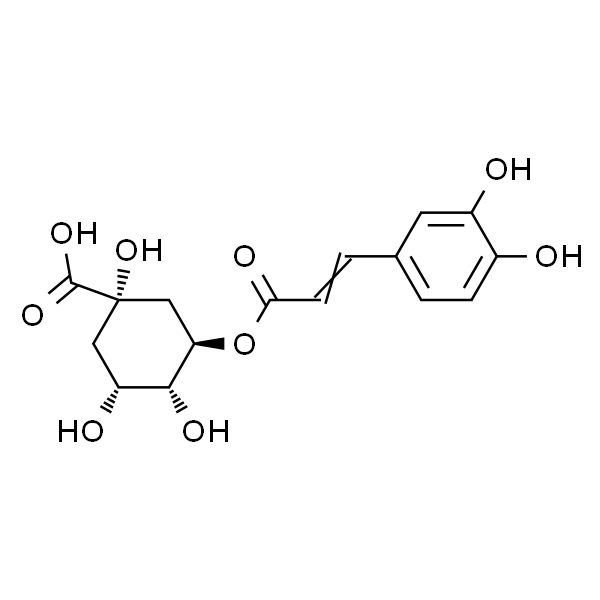
Chlorogenic acid is an ester formed from the reaction of caffeic acid with quinic acid. For researchers working with natural compounds, Solarbio offers Chlorogenic Acid (IC0330) for laboratory research applications. The chemical structure of chlorogenic acid contains an ester bond, an unsaturated double bond and several phenolic groups. The chemical stability of the compound is mainly due to these structural features.
Chlorogenic acid are extracted from plant material during extraction procedures, they can undergo hydrolysis or even intramolecular acyl migrations resulting in isomeric compounds. Thus, the conditions of extraction must be taken into account for the determination of chlorogenic acids in plant extracts.
Why the Molecular Structure Matters
The chemical formula for chlorogenic acid above also gives an indication of the chemical’s structure, which is of importance for its handling. Strong heat, intense light as well as prolonged heating influence the stability of the compound.
When working with natural compounds, researchers must consider the steps between extraction and analysis. The temperature or the time of extraction can influence the sample under investigation, especially if several compounds with related structures, in this case a series of caffeoylquinic acids, are present.
For the working chemist involved in compound handling, this related Solarbio article may also be of interest: How to Choose the Right Solvent When Dissolving Small-Molecule Compounds.
Chlorogenic Acid Isomers and Their Structures
How Caffeoyl Groups Affect Chlorogenic Acid
The number and site of substitution of caffeoyl groups on the quinic acid skeleton determine the chemical structure of the various chlorogenic acid isomers. Ten possible isomers are formed by the mono- and di-caffeoylquinic acids.
The list includes 1-caffeoylquinic acid, 3-caffeoylquinic acid, 4-caffeoylquinic acid and 5-caffeoylquinic acid. The di-caffeoylquinic acid group includes 1,3-di-caffeoylquinic acid, 1,4-di-caffeoylquinic acid, 1,5-di-caffeoylquinic acid, 3,4-di-caffeoylquinic acid, 3,5-di-caffeoylquinic acid and 4,5-di-caffeoylquinic acid.
There are several other forms that occur in plants but have not yet been identified. Chlorogenic acid is the most common form and is referred to as 3-caffeoylquinic acid. There is another form known as Band 510 or cryptochlorogenic acid which is 4-caffeoylquinic acid. Neochlorogenic acid is 5-caffeoylquinic acid.
Isochlorogenic acids A, B, C and cynarin are further plant-derived forms of chlorogenic acid. Isochlorogenic acid A is 3,5-di-caffeoylquinic acid, isochlorogenic acid B is 3,4-di-caffeoylquinic acid, isochlorogenic acid C is 4,5-di-caffeoylquinic acid and cynarin is 1,3-di-caffeoylquinic acid.
Why Isomerization Needs Attention
During extraction of chlorogenic acids from plants the original compound profile may get changed due to hydrolysis of ester structures and acyl migration reactions. During such reactions the caffeoyl group can get shifted to other positions on the quinic acid skeleton.
Comparison of different plant species, extraction procedures and procedures requires consideration of potential differences in sample handling.
Chlorogenic Acid Extraction
Choosing a Suitable Extraction Solvent
Chlorogenic acid can be extracted from plant materials using polar organic solvents such as ethanol, acetone, and methanol. The choice depends on the plant matrix and the purpose of the experiment.
The selection of a solvent for extraction of a compound and the stability of that same compound in solution are two separate considerations. While a solvent may solubilize a compound of interest for extraction, the same method must be controlled for temperature, light, and solution storage time.
Solutions with plant derived compounds are available for different applications and workflows in the lab from Solarbio.
Controlling Temperature and Light
Chlorogenic acids must be extracted at “low” temperature. Strong light must be prevented from entering the extraction area over long periods. Heating for long periods could result in undesirable chemical reactions.
To compare samples extracted at different times it is helpful to keep the extraction conditions as constant as possible for all samples. This applies for the solvent system and the extraction time, the temperature and light exposure.
Chlorogenic Acid Storage Conditions
How to Store Chlorogenic Acid Solutions
Chlorogenic acid test solutions should be stored in the dark in a brown glass bottle. Such solutions are best kept in the refrigerator at about 2°C in order to guarantee greater stability.
Storage of the samples can often be easily over-looked, especially when you are busy processing through many samples at once. Exposing a solution to room temperature, direct light, or even heating it up when it doesn’t need to be, can affect the sample’s condition over time.
For quantitative work, it is crucial to store comparable samples under the same conditions. Otherwise, the analytical results might be influenced by storage instead of the sample itself.
Preparing Solutions for Laboratory Use
A solution can be prepared only in the amount required for the planned experiment. A prepared solution must be protected from light and should not be stored at room temperature for long time.
Researchers studying related biological pathways can also find Solarbio Pathways useful to link their compound studies with pathway-based experiments.
Chlorogenic Acid Preparation
Preparation by Plant Isolation
Chlorogenic acid can be isolated from green coffee beans as part of plant isolation. This method is commonly applied to studies of natural sources and plant material composition.
The final compound profile can depend on the plant material and the isolation process. For this reason, sample preparation and analytical identification are both important when natural extracts are used.
Preparation Through Hydrolysis
Other chlorogenic acids can be made by the hydrolysis of related ester compounds. Chlorogenic acid can also be prepared through the hydrolysis of a related ester compound in methanol using barium hydroxide as a catalyst.
The chemical pathway involves the ester structure of chlorogenic acids. A knowledge of this reaction is essential to understand the process of hydrolysis, and so the transformation and the stability of chlorogenic acid.
Chlorogenic Acid in Natural Product Research
Chlorogenic acid is at the crossroads of plant chemistry and biological research. It can be studied as a single plant derived compound, as a component of extracts derived from nature or in combination with other related caffeoylquinic acids.
In practical research it is important to handle the samples in a clear and controlled manner. This includes the plant material, the solvent, the extraction conditions, storage temperature, light protection and the analysis method. These factors must be kept constant if results are to be compared.
We are still supporting researchers from different fields of life sciences. New products as well as topics of interest to ongoing research are described in the Solarbio News section.
About Solarbio Small Molecule Compounds
Solarbio provides a wide range of high-quality research products for small molecule research, particularly suited for studies with natural compounds and their pathways as well as screening applications. Here you will find information about the company Solarbio as well as about the products related to small molecule research.
Contact Solarbio for further product information, availability or to discuss specific applications.
Conclusion
Chlorogenic acid, a plant derived small molecule of great interest, is a molecule of defined structure which affects its extraction and storage by its chemical constitution. In particular, the ester bond, the unsaturated double bond and the phenolic groups are affected by heat and light.
Some related isomers occur in plants like cryptochlorogenic acid, neochlorogenic acid and the isochlorogenic acids A, B and C. To analyze plant extracts correctly these compounds have to be identified correctly.
Chlorogenic acids can be extracted using ethanol, acetone or methanol. High temperature, strong light or long heating must be avoided when preparing solutions of chlorogenic acids. Chlorogenic acid solutions are best stored in brown glass bottles at about 2°C.
Consistent conditions for extraction and storage of natural samples, even as simple as these, are critical to generate reliable data for natural products research. This helps to compare the amounts of chlorogenic acid and other related compounds in reliable manner.
FAQ
Q1: What is chlorogenic acid?
A1: The compound is an ester of caffeic acid and quinic acid. It has an ester linkage, one unsaturated double bond, and several phenolic groups.
Q2: What are the main chlorogenic acid isomers?
A2: The bioactive forms of coffee of greatest interest include chlorogenic acid, cryptochlorogenic acid, neochlorogenic acid, isochlorogenic acid A, isochlorogenic acid B, isochlorogenic acid C and cynarin.
Q3: What solvents can be used to extract chlorogenic acid?
A3: Chlorogenic acids can be extracted from plant material using ethanol, acetone or methanol solutions, depending on the sample under investigation and the purpose of the experiment.
Q4: Is chlorogenic acid stable during extraction?
A4. Chlorogenic acid may undergo hydrolysis and also intramolecular acyl migration. High temperature, strong light, and long storage at high temperature should be avoided.
Q5: How should chlorogenic acid solutions be stored?
A5: Solutions of chlorogenic acid should be stored in the dark in a brown bottle in the refrigerator at about 2°C.
Q6: Why is chlorogenic acid isomerization important?
A6. Isomerization can alter the composition of chlorogenic acid-related compounds within plant extracts under various circumstances leading to difficulties in comparison with other samples and for assessing results obtained.
Q7: Can chlorogenic acid be prepared chemically?
A7: Yes. This preparation describes the hydrolysis of an ester-like compound using barium hydroxide in methanol solution. Chlorogenic acid can also be extracted from green coffee beans.
Q8: When working with chlorogenic acid what should one watch out for as a researcher?
A8. Attention should be paid to the plant source, the identified compound, isomers, extraction solvents, temperature, light, time of extraction and storage conditions.
 Consult
 Whatsapp
 Leave Message
 top