




Related news
Fatty Acid Oxidation: How Cells Use Fatty Acids for Energy
Table of Contents
Fatty acid oxidation is a fairly simple metabolism pathway. It involves the breakdown of fatty acids in the presence of oxygen to form energy for cells. However, the lab test for fatty acid oxidation does not always work out so simply. While a sample may have a low FAO rate, another sample may have normal activity of the downstream enzymes for FAO, but very poor mitochondrial transport due to a problem with carnitine or CPT-I.
The process of fatty acid oxidation is generally known as β-oxidation in mammals. It is described by the stepwise conversion of long-chain fatty acids into acetyl units that are combined to form acetyl-CoA, which is used for the production of energy in cells by being converted into FADH₂ and NADH in the course of β-oxidation. In the context of studies on lipid metabolism, diabetes, obesity, liver injury, physical exercise, effects on mitochondria, and models of diseases of metabolism, the described pathway of β-oxidation is usually worth analyzing step by step.
Solarbio supplies also Biochemical reagents, biochemical assay kits, biochemical tools for life science research work. When studying of fatty acid oxidation, it is not only enough to know the name of the pathway. You also have to know which enzyme, carrier or intermediate you have to measure.
What Is Fatty Acid Oxidation?
Fatty acid oxidation refers to the processes by which fatty acids are catabolized under aerobic conditions to yield CO₂ and H₂O with the concomitant release of energy. There are several routes of oxidation, i.e., β-oxidation, α-oxidation, ω-oxidation, propionyl-CoA-oxidation, and unsaturated fatty acid-oxidation.
Most studies on mammalian systems describe fatty acids to be mainly broken down by means of beta-oxidation. Beta-oxidation of fatty acids is mainly taking place in the mitochondrial matrix. Also in plants fatty acids are broken down by beta-oxidation. In contrast to most mammalian systems this process is located in peroxisomes of leaves and germinating seeds of plants. As most studies on diseases of lipid-metabolism and on cellular lipid-metabolism are performed on mammalian systems, in this review on beta-oxidation of fatty acids the mammalian systems will be discussed in more detail.
If your project covers other pathways like the TCA cycle, production of ketone bodies or mitochondrial respiration, it may be helpful to view the FAO pathways in the context of other metabolic reaction references instead of just focusing on the single FAO reaction.
Why Liver and Muscle Are Common FAO Samples
Active Energy Metabolism
Active sites for fatty acid oxidation are located in liver and muscle. The liver is involved in many energy-relevant processes including lipid metabolism, the production of ketone bodies, the utilization of acetyl-CoA as well as other reactions. The muscle utilizes fatty acids as fuel under conditions of fasting, prolonged physical exercise or low blood glucose levels.
So for FAO studies, liver and muscle tissues are commonly analyzed. If FAO declines in the liver then there is a potential for increased lipid accuumulation. Changes in muscle FAO can lead to examination of mitochondrial capacity, exercise response or increased metabolic flexibility.
Three Main Parts of the Pathway
The process of fatty acid β-oxidation can be subdivided into 3 stages: 1) activation of the fatty acid, 2) transport of the fatty acyl-CoA into the mitochondria, and 3) repeated rounds of β-oxidation within the mitochondrial matrix.
This split is useful in actual experiments. Measuring only the total FAO rate may show that the pathway changed, but it may not show where the change happened. Checking ACS, CPT-I, carnitine, SACD, MACD, LACD, and FAO rate gives a clearer view of different points in the pathway.
How Fatty Acids Are Activated
Fatty Acyl-CoA Formation
Unencapsulated free fatty acids cannot enter β-oxidation. They first need to be activated. This activation step of fatty acids takes place in the cytosol where they are coupled to CoA-SH in the presence of ATP, Mg²⁺ and fatty acyl-CoA synthetase to form a fatty acyl-CoA.
The activation of lipids for the other steps to follow to form products is taking place at the endoplasmic reticulum and outer mitochondrial membrane. Reactive fatty acyl-CoA molecules are recognized by a variety of enzymes. To investigate the early stages of metabolism of fatty acids, we are now offering the BC0760/BC0765 Acyl-CoA Synthetase (ACS) Activity Assay Kit for the measurement of Acyl-CoA Synthetase activity. Since Acyl-CoA Synthetase is one of the first enzymes studied in the investigation of activation of fatty acids, of substrate flux and of storage/oxidation of lipids, why ACS activity matters.
ACS is often described as the first enzyme in the metabolic pathway of activated fatty acids. The correct view, however, is that of a multifunctional enzyme. As soon as a fatty acid has been converted into a fatty acyl-CoA, it can enter the pathway of β-oxidation of fatty acids, be used for lipid synthesis, become part of a membrane or even serve as precursor for signaling molecules. Changes in the activity of the first enzyme of the metabolic pathway of a substrate most likely have profound effects on metabolism as a whole.
For example, the influence on lipid accumulation can be affected by changes in energy supply and cell stress. Therefore, the activity of ACS is often determined in studies on liver metabolism, in adipocyte models, on muscle energy metabolism as well as in lipid disease models.
How Fatty Acyl-CoA Enters Mitochondria
The Carnitine Shuttle
β-oxidation enzymes are found in the mitochondrial matrix. In the mitochondrial matrix short-chain fatty acids are readily transferred into the mitochondria. In contrast, long-chain fatty acids as their coenzyme A derivative are not be transferred into the mitochondria. The transfer into the mitochondria of long-chain fatty acids is achieved by the carnitine shuttle. In the outer mitochondrial membrane the Carnitine Palmitoyltransferase I (CPT-I), coded for by BC0645, transfers the long-chain fatty acyl groups from their coenzyme A derivative to carnitine to form fatty acyl-carnitine. This fatty acyl-carnitine is then transferred into the mitochondrial matrix by a carrier protein. Inside the mitochondria the fatty acyl groups are then transferred from the carnitine to coenzyme A by the action of the Carnitine Palmitoyltransferase II (CPT-II) and carnitine is released. The activity of CPT-I can be determined using the BC0645 Carnitine Palmitoyltransferase I (CPT-I) Activity Assay Kit for this transport step. If the question is more about carnitine availability, BC0670/BC0675 Free Carnitine / Total Carnitine Content Assay Kit is also useful.
Why Carnitine Should Not Be Ignored
Carnitine is often viewed as a mere carrier and hence is largely ignored in studies of FAO. However, in FAO studies, it can be a rate-limiting step. When free carnitine is low or the total carnitine value is abnormal, long-chain fatty acids are not efficiently transported into the mitochondria. This will result in decreased FAO even when the subsequent enzymes are present in normal quantities.
Measuring activity of CPT-I together with carnitine content is more practical than measuring only one of them.
What Happens in the β-Oxidation Cycle?
Four Repeated Reactions
β-Oxidation of fatty acyl-CoA starts in the mitochondrial matrix. The four steps of a β-oxidation cycle are: 1) dehydrogenation, 2) hydration, 3) second dehydrogenation, 4) thiolysis. Each cycle of the β-oxidation cleaves a fatty acyl chain by two carbon atoms to yield one molecule of acetyl-CoA.
As each round of elongation proceeds the shortened acyl-CoA is returned to the start of the cycle for further elongation until the whole of the fatty acid chain has been broken down.
Dehydrogenation and Chain-Length Enzymes
The first reaction is catalyzed by acyl-CoA dehydrogenase, releasing the hydrogen atoms from the α and β carbon positions as trans-Δ²-enoyl-CoA. FAD is reduced to FADH₂ in the process and can generate ATP in the respiratory chain.
The Acyl-CoA dehydrogenases are all enzymes that act on different lengths of fatty acid chains. The SACD is associated with short-chain-length Acyl-CoA substrates, the MACD is associated with medium-chain-length Acyl-CoA substrates, and the LACD is associated with long-chain-length Acyl-CoA substrates.Therefore, one test result does not necessarily mean that all of the other chain-length groups are normal.
The BC0775 Short-Chain Acyl-CoA Dehydrogenase (SACD) Activity Assay Kit, BC0785 Medium-Chain Acyl-CoA Dehydrogenase (MACD) Activity Assay Kit, and BC0795 Long-Chain Acyl-CoA Dehydrogenase (LACD) Activity Assay Kit can be used to monitor chain-length specific oxidation of fatty acids of short-, medium- and long-chain length, respectively.
Hydration, Second Dehydrogenation, and Thiolysis
The trans-Δ²-enoyl-CoA from the first dehydrogenation step is converted by enoyl-CoA hydratase to the corresponding β-hydroxyacyl-CoA. This β-hydroxyacyl-CoA is then converted by β-hydroxyacyl-CoA dehydrogenase to the corresponding β-ketoacyl-CoA. In this reaction, NAD⁺ is reduced to form NADH and H⁺.
Finally, the enzyme β-ketoacyl-CoA thiolase uses CoA-SH to cleave the molecule β-ketoacyl-CoA. It yields acetyl-CoA and a fatty acyl-CoA molecule that is two carbon atoms shorter than the original molecule.
Acetyl-CoA can be used for TCA cycle. In liver, Acetyl-CoA can also be used for production of ketone bodies. In addition, it is also used for synthesis of cholesterol and steroid compounds. Thus, fatty acid oxidation is not just ‘burning of fat’ and it supplies several other pathways of metabolism.
Why FAO Detection Matters in Research
Lipid Balance and Energy Supply
Fatty acids have a lot of energy. During fasting or long lasting sports activities many tissues shift to using fatty acid oxidation for energy. When oxidation of fatty acids is properly functioning, tissues can use fatty acids for energy and keep a proper lipid balance.
When β-oxidation is slow, fatty acids and intermediate lipids can accumulate. Studies on the liver can show lipid deposition. The FAO rate of tissues from obesity and diabetes models can indicate how these tissues are dealing with the excessive supply of fatty acids. In studies on mitochondria low FAO rates can indicate problems of energy production.
Choosing the Right Readout
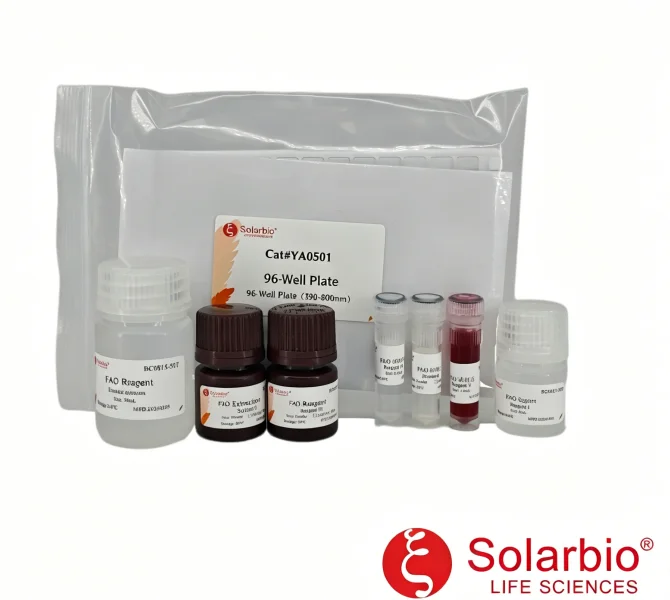
Not every experiment needs every kit. The first kit to consider for a study of the activation of fatty acids would be to measure the activity of ACS. For a study of the mitochondrial uptake of long- and very long-chain fatty acids, then measuring the activity of CPT-I in combination with carnitine would be more appropriate. For studies focusing on the oxidation cycle of fatty acids, the individual kits for SACD, MACD, and LACD would provide more detail. For those studies looking for a general pathway readout, then the BC0815 Fatty Acid Oxidation Rate (FAO) Assay Kit is your best bet.
For broader metabolism projects, it might be helpful to first look at research solutions for this kind of problem and then decide on the indicators based on this information. This is especially true for small amounts of sample or when several different pathways are being studied.
Common Assay Kits Used in Fatty Acid β-Oxidation Research
|
Catalog No. |
Product Name |
Common Use |
|
BC0645 |
Carnitine Palmitoyltransferase I (CPT-I) Activity Assay Kit |
Fatty acid mitochondrial transport |
|
BC0670 |
Free Carnitine / Total Carnitine Content Assay Kit |
Carnitine metabolism detection |
|
BC0675 |
Free Carnitine / Total Carnitine Content Assay Kit |
Carnitine metabolism detection |
|
BC0760 |
Acyl-CoA Synthetase (ACS) Activity Assay Kit |
Fatty acid activation |
|
BC0765 |
Acyl-CoA Synthetase (ACS) Activity Assay Kit |
Fatty acid activation |
|
BC0775 |
Short-Chain Acyl-CoA Dehydrogenase (SACD) Activity Assay Kit |
Short-chain fatty acid oxidation |
|
BC0785 |
Medium-Chain Acyl-CoA Dehydrogenase (MACD) Activity Assay Kit |
Medium-chain fatty acid oxidation |
|
BC0795 |
Long-Chain Acyl-CoA Dehydrogenase (LACD) Activity Assay Kit |
Long-chain fatty acid oxidation |
|
BC0815 |
Fatty Acid Oxidation Rate (FAO) Assay Kit |
Overall FAO rate detection |
Solarbio’s biochemical assays are sold as part of a range of biochemical assay kits. These assays can be used with a variety of tissues, cells and other biological samples. Please see individual product protocols for more information.
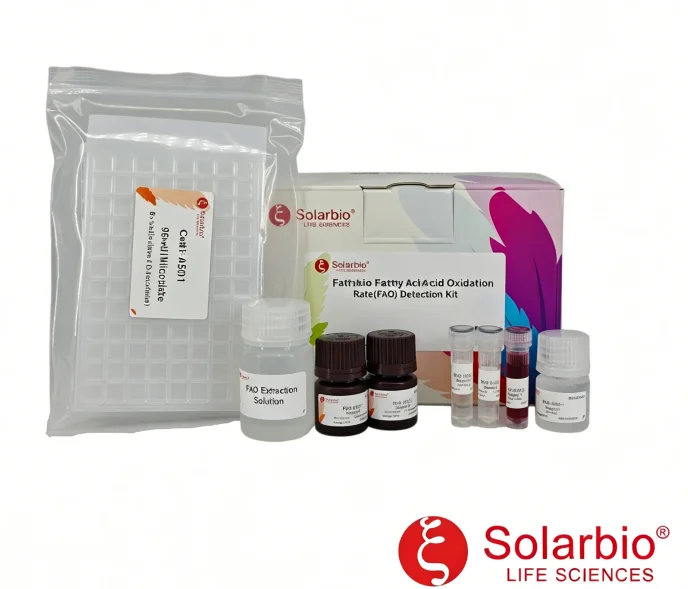
For researchers who are unsure about certain aspects of a protocol they are to follow, Solarbio technical service support can clarify information on whether a researcher has chosen the right sample, the right detection method and the right kit for their samples prior to running their actual samples for the experiment.
Conclusion
Fatty acid oxidation is a key metabolic pathway in energy metabolism research. In order to be degraded in β-oxidation, fatty acids have to be activated, to be transported into the mitochondria, where the β-oxidation itself takes place in the mitochondrial matrix by a number of enzymes. By β-oxidation long chain fatty acids are degraded to acetyl-CoA, FADH2 and NADH, all of which are important for energy production.
For experimental determination of FAO, FAO should not be expressed as a single number, because ACS, CPT-I, carnitine, SACD, MACD and LACD each measure a different part of the pathway. The appropriate indicator for explaining results and reducing sample waste must therefore be chosen.
If you have questions about choosing a product, sample compatibility, or experimental protocols, we would be happy to have Solarbio answer your questions prior to your initiating an experiment.
FAQ
Q1: What is fatty acid oxidation?
A1: Fatty acid oxidation is the process of degradation of fatty acids under aerobic conditions to release energy. In mammalian cells this process is almost entirely carried out by the process of beta-oxidation.
Q2: Where does fatty acid β-oxidation take place in mammalian cells?
A2: β-oxidation of fatty acids takes place in the mitochondrial matrix. The long-chain fatty acyl-CoA is first transferred into the mitochondria by the carnitine shuttle.
Q3: Why do fatty acids need to be activated first?
A3: Free fatty acids cannot directly enter β-oxidation. They need to be converted into fatty acyl-CoA by fatty acyl-CoA synthetase with ATP, CoA-SH, and Mg²⁺.
Q4: What is the role of CPT-I in fatty acid oxidation?
A4: CPT-I is an outer mitochondrial membrane enzyme that converts long-chain fatty acyl-CoA to the fatty acyl-carnitine form, allowing the fatty acid to be transported across the outer mitochondrial membrane and then across the inner mitochondrial membrane where it is activated to its CoA form and then beta-oxidized.
Q5: What are SACD, MACD, and LACD used for?
A5: SACD, MACD, and LACD are used to test short-chain, medium-chain, and long-chain acyl-CoA dehydrogenase activity.
 Consult
 Whatsapp
 Leave Message
 top
top