




Abscisic Acid (ABA): Plant Functions, Solubility, and Solution Preparation
ตารางเนื้อหา
Abscisic Acid, or ABA, is familiar to anyone who has worked with seed dormancy, drought treatment, plant tissue culture, or hormone response experiments. It is usually introduced as a plant growth inhibitor. That is useful as a first description, but in day-to-day research, ABA is doing more than simply slowing a plant down.
A seed may stay dormant longer after ABA treatment. Leaves may lose less water because stomata close. A stressed plant may change the expression of genes involved in dehydration, metabolism, or protection. The response depends on the plant, the tissue, and the treatment stage.
That is also why ABA experiments can look simple on paper and still give very different results between two labs.
What ABA Does Inside a Plant
ABA is a naturally occurring plant hormone. Its molecular formula is C15ชม20O4 and its molecular weight is about 264.32 g/mol.
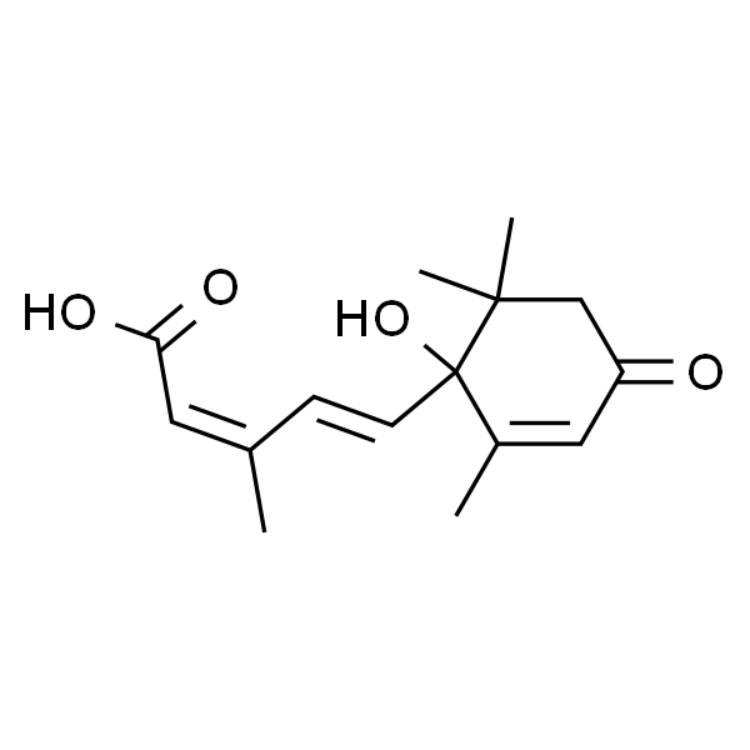
The name often comes up when plants are short of water. Under drought or osmotic stress, ABA can rise quickly. Stomata then begin to close, which cuts water loss through transpiration.
For the plant, this is a trade-off. Less open stomatal area also means less gas exchange. Growth may slow, but water is saved.
Seed behavior is another common reason to use ABA in the lab. ABA is strongly associated with dormancy and can suppress germination when the seed is not ready to grow.
Seed Dormancy Is Not Just “ABA Stops Germination”
It is easy to describe ABA as the brake and Gibberellic Acid, GA3 as the accelerator. That comparison is useful, but real seed physiology is messier.
A germinating seed is responding to hormone levels, tissue sensitivity, developmental stage, temperature, light, moisture, and its own genetic background. ABA can oppose processes promoted by gibberellins, including alpha-amylase production in cereal seeds, but the result is not determined by concentration alone.
Two seed batches treated with the same amount of ABA can behave differently if their physiological state is not the same.
Researchers who are comparing hormone response with a wider signaling experiment may also find Solarbio’s แหล่งข้อมูลเส้นทางการวิจัย useful when setting up the rest of the workflow.
A Few Chemical Details Matter Before You Make the Stock
ABA is a small molecule, but it is not especially friendly to plain water.
It has low water solubility, so trying to make a concentrated aqueous stock directly often ends with material sitting on the tube wall or at the bottom. Methanol, ethanol, acetone, and some alkaline solutions are much better at getting it into solution.
This is worth checking before weighing anything. A stock that looks almost clear can still contain fine crystals, and that means the actual treatment concentration is lower than the number written on the tube.
โซลาร์บิโอ supplies IA1120 ABA for research use. The product is listed as Abscisic Acid and is used in plant growth regulation and plant tissue culture applications.
Natural ABA and Synthetic ABA Are Not Always the Same Thing
ABA has a chiral center.
The naturally active form found in plants is mainly (+)-ABA, also written as (S)-ABA. Synthetic material may contain both optical forms depending on how it was produced.
There is another detail that sometimes gets overlooked. ABA can also exist in different geometric forms around the double bonds in its side chain. Natural ABA is mainly the 2-cis,4-trans form.
For routine work this may not change how you pipette the reagent, but it matters when experiments from different suppliers or different ABA preparations are compared.
Strong light is not helpful either. ABA can undergo photoisomerization, especially with UV exposure. There is no need to work in complete darkness, but leaving a stock under a strong lamp for hours is avoidable.
Making an ABA Stock Without Turning It Into a Solubility Problem
A practical way to prepare ABA is to decide on the final stock concentration first, then choose the smallest reasonable amount of solvent that will dissolve it fully.
Say you want 10 mL of a 10 mM stock.
ABA has a molecular weight of about 264.32 g/mol, so the calculation gives roughly 26.4 mg for that volume and concentration.
Do the calculation before adding solvent. Weigh the powder, add the chosen solvent, and make sure it is fully dissolved before adjusting to the final volume.
That last part gets skipped surprisingly often.
Ethanol Is Common, but the Final Solvent Level Still Matters
Ethanol is a practical choice for many plant experiments. Solarbio IA1120 has also been used in published plant work with ethanol-prepared ABA stocks. One recent Populus study prepared a 10 mM ABA stock in anhydrous ethanol before dilution to the working concentration.
The important part is not that ethanol is always the “best” solvent. It is that the same solvent background should be present in the control.
If an ABA-treated seedling receives 0.1% ethanol after dilution, the mock group should receive 0.1% ethanol as well.
Otherwise there are two variables in the experiment.
The same problem appears with other poorly water-soluble compounds, which is why solvent choice comes up repeatedly when choosing biochemical reagents.
ABA Does More Than Change the Way a Plant Looks
ABA can alter transcription, protein synthesis, enzyme production, and downstream stress responses. In cereal grains, one classic example is its ability to oppose gibberellin-driven alpha-amylase production.
That is why an ABA treatment is often followed by something else. qPCR may be used to measure an ABA-responsive gene. A transcriptome experiment may look for a broader stress signature. Enzyme activity, ROS, stomatal aperture, root length, or germination rate can all be useful depending on the question.
The hormone treatment itself is only the first step.
When ABA Gives an Odd Result, Check the Boring Things First
An ABA treatment that does almost nothing does not immediately mean the plant is insensitive.
Start with the stock.
Was everything dissolved? Was the correct molecular weight used? Was the stock made at the concentration written on the label? Has the tube been opened and warmed many times?
Then look at the biology.
Old seeds and fresh seeds may not respond alike. Leaves and roots do not have the same sensitivity. A concentration copied from Arabidopsis may not translate cleanly to maize, tomato, cotton, or a woody plant.
Treatment time matters too. Six hours, two days, and three weeks are not different versions of the same experiment.
High Concentration Is Not Automatically Better
More ABA can give a stronger effect, but there is a point where the treatment stops being useful for the question being asked.
If the concentration is too high, growth may be suppressed so strongly that secondary stress effects begin to dominate. It becomes difficult to tell which response belongs to the pathway of interest and which one is simply the result of a badly stressed plant.
For a new species or tissue, it is usually safer to test a small concentration range first.
That quick pilot often saves more time than trying to rescue one large experiment later.
Storage Gets Important Once the Bottle Has Been Opened
Dry ABA is easier to manage than a working solution.
The IA1120 product page lists storage at -20°C for the product. Once a stock has been made, repeated warming and cooling is best avoided.
Small aliquots solve most of that problem.
Prepare enough for the planned set of experiments, split the stock into sensible volumes, label the solvent and concentration clearly, and only thaw what is needed.
This is ordinary bench practice, but it becomes especially useful with hormone experiments because a weak stock can be mistaken for a weak biological response.
When a project involves several plant hormones or an unusual sample system, Solarbio’s บริการทางเทคนิค can also be used for product and application questions.
ข้อสรุป
ABA looks simple when it is written as one reagent on an experimental plan. In practice, its effect depends on both the biology and the way the stock was handled.
It can suppress germination, support dormancy, influence stomatal closure, alter growth, and change downstream RNA and protein responses. None of that means every plant will react the same way to one fixed concentration.
Make the stock properly. Keep the solvent control matched. Protect the solution from unnecessary light, and avoid treating the concentration from another species as a universal starting point.
If a specific ABA product, plant material, or treatment setup needs to be matched before an experiment begins, researchers can ติดต่อ Solarbio with the species, sample type, concentration range, and planned endpoint.
คำถามที่พบบ่อย
Q1: What is Abscisic Acid mainly used for in plant experiments?
A1: ABA is commonly used in work on seed dormancy, germination, drought response, stomatal behavior, stress signaling, plant growth, and hormone interaction.
Q2: Can ABA be dissolved directly in water?
A2: Not very well at high concentration. ABA has low solubility in neutral water, so concentrated stocks are usually prepared with a suitable organic solvent or another compatible solubilization approach.
Q3: How much ABA is needed for a 10 mM stock?
A3: For 10 mL of a 10 mM stock, about 26.4 mg ABA is required when using a molecular weight of 264.32 g/mol.
Q4: Why should an ABA experiment include a solvent control?
A4: The solvent can affect the plant by itself. The control should therefore contain the same final solvent concentration as the ABA-treated group.
Q5: Does ABA always inhibit plant growth?
A5: No. Growth inhibition is one possible response. ABA also takes part in water control, seed maturation, dormancy, stress signaling, gene regulation, and several other processes.
Q6: What is the relationship between ABA and Gibberellic Acid, GA3?
A6: They often have opposing roles in seed dormancy and germination. ABA generally supports dormancy, while Gibberellic Acid, GA3 tends to favor germination and related metabolic activity.
Q7: Why can the same ABA concentration produce different results?
A7: Species, cultivar, tissue, plant age, treatment time, environmental conditions, stock quality, and hormone sensitivity can all change the response.
Q8: How should an ABA stock be stored?
A8: Follow the storage instructions for the specific product. For prepared stocks, small aliquots are useful because they reduce repeated warming and opening of the same tube.
 ปรึกษา
 Whatsapp
 ทิ้งข้อความ
 ด้านบน