



Folin-Ciocalteu Total Polyphenol Assay Guide | Solarbio
Table of Contents
Ask anyone who runs polyphenol assays and you’ll hear the same thing. The chemistry is easy. The consistency isn’t. Run the same Folin-Ciocalteu protocol in two labs and you can still end up with two very different gallic acid numbers. Such discrepancies are not uncommon, even when laboratories follow the same protocol. The reagent bottle usually opens that gap: weak linearity on the curve, a blank that won’t sit still, color that wanders between batches. That all ends up in your published data.
Below I’ll go through what the reaction actually measures, which national standards call for it, and how I’d judge a Folin reagent before betting a study on it.
What the Folin-Ciocalteu Reaction Actually Measures
So what’s actually in the bottle? Phosphomolybdic acid mixed with phosphotungstic acid, that’s the reagent. Once the buffer goes alkaline, your phenolics start reducing the molybdenum (Mo⁶⁺) and the tungsten (W⁶⁺) in it. Down to Mo⁵⁺ and W⁵⁺. In the cuvette you get a deep blue complex out of this. Absorbance peaks near 760 nm. More phenolic hydroxyl groups in the sample, stronger the color. Simple as that.
You quantify against gallic acid. That’s why every result reads out as gallic acid equivalents (GAE).
One thing people forget. The reaction can’t tell a phenol from any other reducing agent. Ascorbic acid, for one, gives plenty of signal. Certain sugars too. So matrix matching and blanking discipline matter just as much as pipetting.
Which Standards and Matrices Call for It
So why do regulators keep coming back to it? It’s fast and it’s cheap. Standardizing it is painless too. That’s the track record:
- GB/T 8313-2018 — determination of tea polyphenols and catechins in tea
- GB/T 44349-2024 — determination of total polyphenols in bee pollen
- LS/T 6119-2017 — determination of polyphenols in vegetable oils by spectrophotometry
Academic labs reach for it as well. Plant natural product chemistry uses it. So does food science, and half the antioxidant pharmacology literature. You’ll see it run on tea and fruit and vegetable extracts, on traditional Chinese medicine samples, on plant oils, honey, wine, functional foods. The list keeps growing. Little equipment needed, and crude extracts won’t break it. Early-stage work runs on exactly that.
Planning a batch? Two things I’d do first. Dilute dark or strongly colored samples until the color stops fighting the blue complex, and keep dilution factors identical across the series you want to compare. And don’t trust a new matrix until a dilution series shows the signal lands inside your standard curve.
Plant side? Careful here, because compounds like chlorogenic acid oxidize and degrade while you extract. Our earlier piece on chlorogenic acid structure and stability explains why that happens and how to slow it down.
What Actually Separates One Folin Reagent from Another
On paper? Identical chemistry. In the lab, purification steps and batch control show up in your curve, in the blank, and in how well your replicates agree. That’s where reagents part ways.
The Side-by-Side Numbers
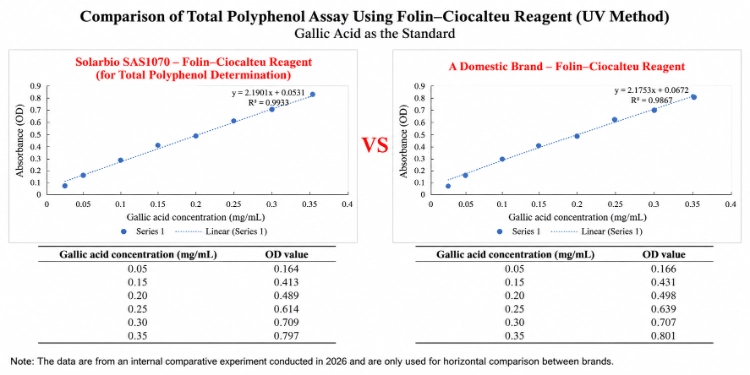
We set up one comparison under strictly identical conditions. Gallic acid gradient standards, catalog number SVG1005. Same color development system, same instrument, same incubation times. SAS1070 on one side, a second domestic Folin reagent on the other.
|
Metric |
Solarbio SAS1070 |
Second domestic reagent |
|
Standard curve R² |
≈ 0.9933 |
≈ 0.9867 |
|
Blank absorbance |
0.050 |
0.058 |
|
Repeatability across replicates |
Good |
Good |
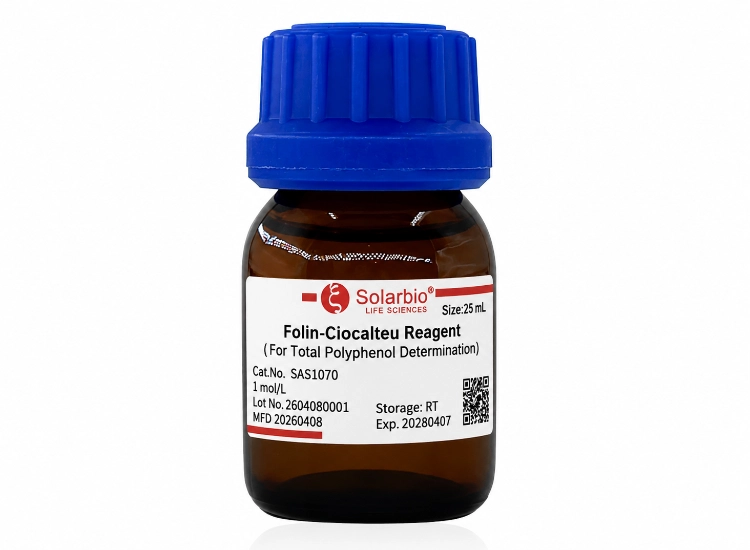
Alone, neither number is dramatic. Together they tell a story. A higher R² pushes your detection limit down. So does a quieter blank. That combination is what makes low-polyphenol samples measurable at all. SAS1070 ships as a 1 mol/L application-ready reagent for total polyphenol determination, purified in several stages, formulated for stability. It works straight out of the bottle, and the batches hold.
Running It Without Surprises
Make the diluted working reagent fresh. Every time. Diluted, it degrades fast. The stock bottle stays sealed and dark at 2 to 8°C. Six months, that’s the lifespan once it’s open.
For curves: one gallic acid reference, one timing scheme, blanks corrected the same way on every run. Reviewers ask about those variables first.
Sample prep gets the same argument. Phenolics oxidize. They grab proteins. Where they partition depends on your extraction solvent. So grind uniformly, extract consistently, and run duplicates from the first dilution. If a result looks off, check the blank before you blame the sample. Drifting blank absorbance can compromise polyphenol assay results, sometimes causing greater problems than pipetting errors.
The Bottom Line
Regulated matrices? No choice to make. For tea, for bee pollen, and for vegetable oils, the standard names the method, and that’s that. Folin-Ciocalteu it is.
Research samples are another story. Here’s where being picky pays. Count the reagent as part of your data quality. Linearity and blank values deserve the same scrutiny a pipette calibration gets. A straighter curve and a quieter blank will outlast any small price saving once the thesis is printed.
Beijing-based Solarbio has been at this since 2004. Four ISO certifications on the wall (9001, 13485, 14001, 45001), and the stock list runs north of 100,000 products. Company background lives on the about Solarbio page. Most of what a spectrophotometric workflow needs sits in the biochemical reagent portfolio, and SVG1005 itself comes from the analytical standard line, where HPLC, NMR, or MS verification happens before anything ships.
Running total polyphenols on a new matrix for the first time? Contact the Solarbio team with your sample type and target range. They’ll say plainly whether the method fits.
Common Questions from Labs
Q1. Can I read the blue complex on a microplate reader instead of a UV-Vis spectrophotometer?
Yes. Plate readers handle it fine once you’ve got UV-compatible plates, and frankly it’s the only sane option when your sample list hits forty. Two rules, though. Match volumes and incubation windows to the protocol behind your chosen standard. And run the gallic acid curve in the same plate. Same timing, too. A calibration built on another instrument? Don’t let it travel.
Q2. How should Folin-Ciocalteu reagent be stored?
Stock bottle: sealed, dark, 2 to 8°C, and use an opened one up inside six months. Working reagent is a different animal. Make it the morning you need it. Overnight on the bench, and the bottom of your curve goes first. And match the dilution volume to your actual sample count, not the protocol default. Half-empty plates waste reagent. Overfull ones leave you dry mid-assay.
Q3. What gallic acid standard works for the calibration curve?
Go with a UV spectrophotometry-grade reference. SVG1005 is the one we’d name, built for exactly this kind of UV quantification. Generic research-grade gallic acid carries looser purity tolerances. Sounds minor. It isn’t, because on this method the standard’s uncertainty shows up in every single number downstream.
 Consult
 Whatsapp
 Leave Message
 top