





ACE vs ACE2: Key Differences, Functions, and Activity Assays
Tabla de Contenidos
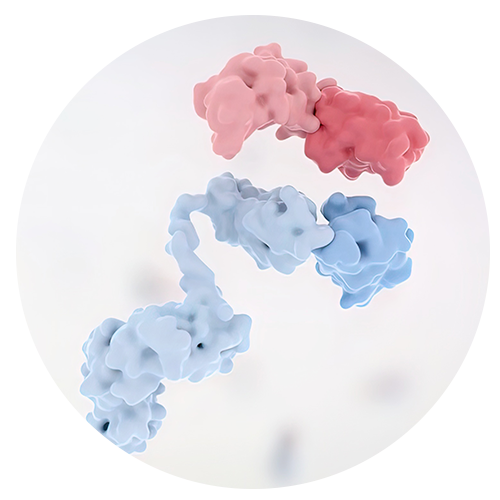
ACE and ACE2 sound like two versions of the same enzyme. Their names differ by just one number, and both belong to the same protein family. But they do very different jobs inside the body.
Angiotensin Converting Enzyme (ACE) helps produce Angiotensin II (Ang II), a hormone that raises blood pressure. Angiotensin Converting Enzyme 2 (ACE2) breaks down Ang II and helps limit some of its effects.
That difference matters in cardiovascular research, kidney disease, metabolic disorders, and drug development. ACE inhibitors are widely used to treat hypertension, while ACE2 has attracted attention for its protective functions and its role as a receptor for SARS-CoV-2.
For laboratories studying these enzymes, understanding their biological roles is only part of the work. Choosing the right activity assay and inhibitor screening method matters just as much. Solarbio provides related biochemical research tools through its life science product portfolio.
How Do ACE and ACE2 Work in the Renin-Angiotensin System?
The renin-angiotensin system (RAS) regulates blood pressure, fluid balance, and electrolyte levels. It also affects inflammation and tissue responses in the heart, kidneys, blood vessels, and lungs.
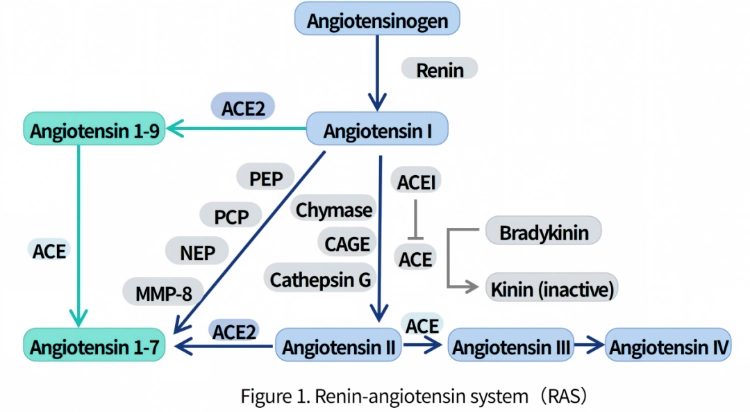
When blood pressure or renal perfusion falls, the kidneys release renin. This enzyme converts angiotensinogen into Angiotensin I (Ang I). ACE then converts Ang I into Ang II.
Ang II acts mainly through the angiotensin II type 1 receptor (AT1R), promoting blood vessel constriction, aldosterone release, and sodium retention.
ACE Drives Ang II Production
ACE, also called ACE1, is a zinc-dependent metallopeptidase classified as EC 3.4.15.1.
It is widely expressed in vascular endothelial cells, particularly in the lungs, and is also found in the kidneys, intestines, and other tissues.
ACE removes a dipeptide from Ang I to produce Ang II. Under prolonged or excessive activation, Ang II signaling can contribute to oxidative stress, inflammation, and tissue fibrosis.
Researchers measuring this pathway can use the Solarbio BC5540 ACE Activity Assay Kit to assess ACE catalytic activity in suitable biological samples.
ACE2 Helps Counterbalance Ang II
ACE2, classified as EC 3.4.17.23, works differently.
It removes a single amino acid from Ang II to produce Ang-(1-7), a peptide associated with the Mas receptor pathway. This pathway can support vasodilation and reduce inflammatory and fibrotic responses in several experimental settings.
ACE2 can also convert Ang I into Ang-(1-9), although Ang II is generally a preferred physiological substrate.
The two enzymes therefore influence different sides of RAS signaling. Their activities are connected, but they should not be treated as interchangeable measurements.
ACE vs ACE2: Why Similar Enzymes Behave Differently
ACE and ACE2 share roughly 40% amino acid sequence identity in their homologous catalytic regions. Both require zinc for catalytic activity.
Their substrate preferences and cleavage mechanisms are different.
ACE acts mainly as a dipeptidyl carboxypeptidase, removing two amino acids from suitable substrates. ACE2 acts as a monocarboxypeptidase, removing one amino acid.
This difference affects which peptides each enzyme can process and which inhibitors work against them.
ACE also breaks down bradykinin, a peptide involved in blood vessel relaxation. Reduced bradykinin breakdown helps explain why some patients taking ACE inhibitors develop a persistent dry cough.
Classic ACE inhibitors such as captopril and enalaprilat do not effectively inhibit ACE2 at ordinary pharmacological concentrations.
That is one reason an ACE activity assay cannot simply be used as an ACE2 assay. Different substrates and enzyme controls are needed.
What Happens When the ACE/ACE2 Balance Changes?
Cardiovascular and Metabolic Disorders
Excessive Ang II signaling is involved in hypertension, cardiac remodeling, and kidney damage.
In some disease models, increased ACE activity or reduced ACE2 function shifts RAS signaling toward vasoconstriction, oxidative stress, and inflammation.
ACE2 activity may help oppose these changes through Ang-(1-7) production.
The response is not identical in every disease or tissue, though. ACE2 expression can increase or decrease depending on the experimental model, injury stage, and cell type.
Measuring both enzymes can therefore be more useful than assuming that one must rise whenever the other falls.
ACE2 Has Functions Beyond Blood Pressure
ACE2 is also a cell-surface receptor used by several coronaviruses, including SARS-CoV, SARS-CoV-2, and HCoV-NL63.
SARS-CoV-2 attaches to ACE2 through its spike protein as part of the viral entry process.
ACE2 also works with the neutral amino acid transporter B0AT1 (SLC6A19) in the intestine, helping maintain transporter expression and amino acid absorption.
These functions involve different regions and interactions of the same protein. In particular, ACE2’s catalytic activity is not required for its role as a viral binding receptor.
ACE Inhibitors and ACE2 Inhibitors Have Different Research Uses
ACE Inhibitors in Hypertension and Peptide Research
ACE inhibitors reduce Ang II production and are established medicines for conditions such as hypertension and heart failure.
They are also important research targets in food science.
Proteins from milk, grains, mushrooms, and other sources can be hydrolyzed to produce peptides with potential ACE inhibitory activity.
The Solarbio BC5570 ACE Inhibitor Activity Assay Kit supports laboratory screening by measuring changes in ACE-catalyzed substrate hydrolysis.
An inhibitory result in vitro does not automatically mean a peptide will lower blood pressure in humans. Digestion stability, absorption, effective concentration, and biological availability still need investigation.
ACE2 Inhibitors in Experimental Research
ACE2 inhibitors are used to examine enzyme function, Ang II metabolism, and related signaling pathways.
Their role in antiviral research requires a separate consideration.
Blocking ACE2 catalytic activity does not necessarily prevent a coronavirus spike protein from binding to ACE2. An effective antiviral approach must interfere with viral attachment, entry, or another required infection step.
Preserving the normal protective functions of ACE2 is also important when evaluating possible interventions.
For inhibitor studies involving either enzyme, selectivity should be checked carefully. Solarbio’s article on off-target effects of small molecule inhibitors discusses why a strong inhibition signal alone cannot establish target specificity.
How to Choose ACE and ACE2 Activity Assay Kits
ACE Activity Detection and Inhibitor Screening
ACE activity can be measured using the synthetic substrate FAPGG.
When ACE hydrolyzes FAPGG, absorbance at 340 nm decreases. The rate of this change can be used to calculate enzyme activity under defined reaction conditions.
Solarbio offers the BC5545 ACE Activity Assay Kit for microplate-based measurements. The BC5540 version uses a spectrophotometric format.
For testing potential inhibitors, BC5570 provides a spectrophotometric option, while the BC5575 ACE Inhibitor Activity Assay Kit supports microplate-based screening.
The choice depends on sample number, available instruments, and experimental design.
ACE2 Activity and Inhibitor Assays
ACE2 generally requires a different substrate system.
Fluorogenic peptide substrates can produce a measurable fluorescence signal after cleavage by ACE2. Under suitable conditions, the signal reflects catalytic activity.
Solarbio offers the BC906F Angiotensin Converting Enzyme 2 (ACE2) Activity Fluorometric Assay Kit and the BC914F Angiotensin Converting Enzyme 2 (ACE2) Inhibitor Activity Fluorometric Assay Kit.
BC906F is intended for studying ACE2 enzyme activity, while BC914F supports inhibitor activity evaluation.
Researchers should confirm the specified substrate, excitation and emission settings, compatible sample types, and calculation method before beginning an experiment.
Getting Reliable Enzyme Activity Results
Enzyme activity can change during sample preparation.
Temperature, pH, sample storage, and reaction timing may affect the result before the plate reaches the reader.
For inhibitor screening, blank controls, uninhibited enzyme controls, and suitable positive controls help distinguish genuine inhibition from background changes.
Fluorescent compounds deserve particular attention because they may alter fluorescence independently of enzyme activity.
Good sample handling and reagent compatibility remain important across biochemical experiments. Further practical information is available in Solarbio’s guide to biochemical reagents for immunology and protein research.
Conclusión
ACE and ACE2 are closely related enzymes, but their functions are not the same.
ACE promotes Ang II formation, while ACE2 helps convert Ang II into Ang-(1-7). Their activities influence cardiovascular regulation, inflammation, and organ function.
ACE inhibitors have established therapeutic applications. ACE2 inhibitors remain useful research tools, but inhibiting ACE2 enzyme activity should not be confused with blocking viral entry.
For laboratory work, the important question is whether the experiment needs to measure enzyme activity, screen inhibitors, or investigate a broader biological pathway.
Solarbio provides ACE and ACE2 activity assay kits for these different research needs. Laboratories requiring help with assay selection or product compatibility can Contacta con Solarbio for technical assistance.
Preguntas frecuentes
Q1: What is the main difference between ACE and ACE2?
A1: ACE converts Angiotensin I into Angiotensin II, which promotes blood vessel constriction. ACE2 converts Angiotensin II into Ang-(1-7), which can support vasodilation and help counterbalance excessive Ang II signaling.
Q2: Can ACE inhibitors also inhibit ACE2?
A2: Common ACE inhibitors such as captopril and enalaprilat do not significantly inhibit ACE2 at typical pharmacological concentrations. The enzymes have different catalytic properties and inhibitor sensitivities.
Q3: Does inhibiting ACE2 prevent SARS-CoV-2 infection?
A3: Not necessarily. ACE2 enzyme activity and its role as a viral receptor are different functions. Inhibiting its catalytic activity does not automatically stop spike protein binding or viral entry.
Q4: How is ACE activity measured in the laboratory?
A4: One common method uses FAPGG as a substrate. ACE-catalyzed hydrolysis causes a decrease in absorbance at 340 nm. The change over time is used to calculate enzyme activity.
Q5: Which Solarbio kits are available for ACE and ACE2 research?
A5: Solarbio offers BC5540 and BC5545 for ACE activity detection, BC5570 and BC5575 for ACE inhibitor screening, BC906F for ACE2 activity detection, and BC914F for ACE2 inhibitor activity testing. Researchers should select the kit that matches their target enzyme, detection method, and experimental requirements.
 Consultar
 Aplicación Whatsapp
 Dejar mensaje
 arriba