



関連ニュース
22 PITC Pre-Column Derivatization Amino Acid Assay Kits for HPLC Analysis | Solarbio
目次
Amino acid testing comes up every day in the lab. Plant researchers use it to study stress responses. Food labs need it for nutritional quality and flavor work. Animal nutrition studies rely on it too. So do fermentation and cell metabolism projects.
The hard part? Amino acids are not easy to detect or separate. A well-prepared sample can still give weak signals. Or peaks that overlap. Usually the analytical conditions are to blame.
Solarbio now offers 22 PITC pre-column derivatization amino acid assay kits. Each kit is built for quantifying one amino acid by HPLC. Sample extraction, chemical derivatization and UV detection are combined in one practical workflow.
Want related products for amino acid analysis and other biochemical measurements? Take a look at the Solarbio biochemical assay kit range.
Why Is Amino Acid Quantification Difficult?
Weak UV Absorption and Similar Chemical Structures
Here is the core problem. Many amino acids have no strong UV-absorbing groups. A standard UV detector struggles with them. Your sample may contain plenty of amino acid. The detector still gives a weak response at the chosen wavelength.
Separation brings its own trouble. Amino acids look alike chemically. Similar polarity. Similar structures. Without the right chromatographic conditions, peaks crowd together or overlap completely.
Then there is the matrix. Plant extracts carry pigments and sugars. Animal tissue and fermentation samples bring other interfering substances. Each matrix affects extraction efficiency, peak separation and the final numbers.
Why Derivatization Makes a Difference
Derivatization changes the game. A chemical reaction converts amino acids into compounds that detect easily. It also changes how they behave on the column. So a conventional HPLC system works fine. No need for a specialized detector.
Reaction conditions still matter, though. Incomplete derivatization skews results. So does a wrong pH. Even small differences in reaction time can shift the measured response.
One rule for quantitative work: standards and samples must go through the same preparation. If you are reviewing calibration procedures, Solarbio’s article on Chromatographic Reference Standards for Method Validation is worth a read.
How Does PITC Pre-Column Derivatization Work?
PITC Reaction Principle and Detection at 254 nm
PITC stands for phenyl isothiocyanate. Under alkaline conditions it reacts with amino groups.
What happens chemically? The amino group attacks the isothiocyanate group of PITC. The product is a phenylthiocarbamyl amino acid derivative. Most people just call it a PTC-amino acid.
These derivatives absorb UV light at about 254 nm. That means a conventional variable wavelength detector (VWD) can handle the measurement.
A useful bonus: PITC reacts with both primary and secondary amino groups. Proline works. So do the common primary amino acids.
The Solarbio PITC method runs at room temperature for one hour. Detection limits go as low as 0.2 μg/mL for applicable targets under the specified conditions. The PTC-amino acid derivatives stay stable for up to 24 hours. That gives you room to process several samples in one analytical batch.
Solarbio 22 PITC Amino Acid Assay Kits
Individual Kits for Common Amino Acids
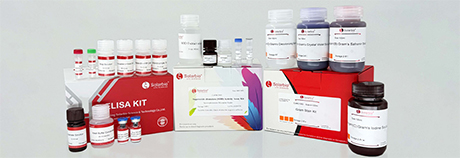
The series covers 22 amino acid targets. Every kit comes in a 50T/48S specification.
Working with acidic and related amino acids? The range includes BC741H Aspartic Acid (Asp) Content Assay Kit, BC742H Glutamic Acid (Glu) Content Assay Kit, BC759H Glutamine (Gln) Content Assay Kit and BC761H Asparagine (Asn) Content Assay Kit.
For other common targets there is BC743H Serine (Ser), BC744H Glycine (Gly), BC745H Histidine (His), BC746H Arginine (Arg), BC747H Threonine (Thr), BC748H Alanine (Ala) and BC749H Proline (Pro) Content Assay Kits.
More options round out the series: BC751H Tyrosine (Tyr), BC752H Valine (Val), BC753H Methionine (Met), BC754H Cystine (Cys-Cys), BC755H Isoleucine (Ile), BC756H Leucine (Leu), BC757H Phenylalanine (Phe), BC758H Lysine (Lys) and BC764H Tryptophan (Trp) Content Assay Kits.
Two specialized kits sit outside the standard amino acid list. BC762H Gamma-Aminobutyric Acid (GABA) Content Assay Kit. And BC763H Theanine (Thea) Content Assay Kit.
Pick what you actually need to measure. Nothing more.
Running a broader amino acid derivatization setup? Solarbio also offers the SDK1020 Amino Acid Derivatization Kit (PITC method, without standard), listed under Analytical Standard Department range.
HPLC Amino Acid Testing: A Pumpkin Seed Example
Sample Extraction and PITC Derivatization
Pumpkin seeds make a good demo sample. Food composition and nutrition studies care about their amino acids. And the PITC method shows well on them.
Start with 200 mg of pumpkin seed powder. Add 1 mL of extraction reagent. Vortex. Then ultrasonic extraction, followed by centrifugation. Keep the supernatant.
Now for derivatization. Transfer 50 μL of sample solution into a reaction tube. Add 250 μL of Derivatization Reagent I. Then 250 μL of Derivatization Reagent II. Mix and let it sit at room temperature for one hour. After that, add 50 μL of Derivatization Reagent III and mix again.
Sample Cleanup and HPLC Conditions
Cleanup comes next. Add 1 mL of n-hexane. Vortex for one minute. Remove the upper layer. Dilute the lower solution with Mobile Phase A.
Filter through a compatible 0.22 μm organic membrane before injection. Do not skip this step.
Example conditions: column temperature 40°C, flow rate 1.0 mL/min, detection at 254 nm, injection volume 10 μL, and a 50-minute gradient elution program.
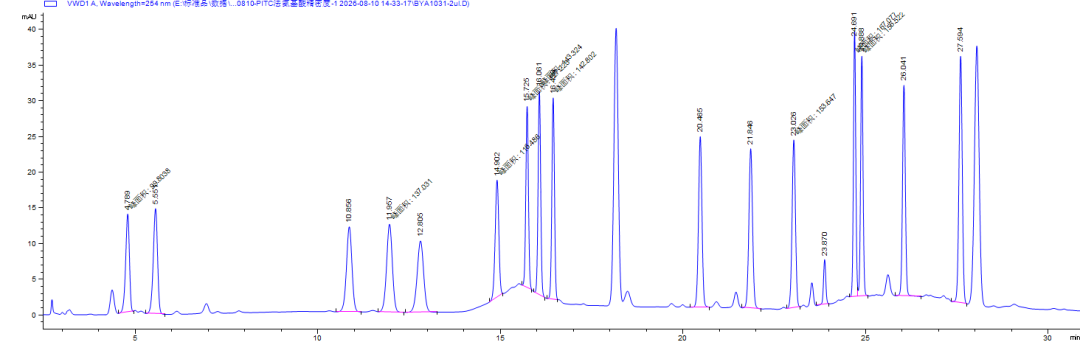
Treat these numbers as a starting reference. Check the separation for each new sample type.
Working across plant metabolism, food analysis and other fields? Solarbio’s 研究ソリューション page lists options worth exploring.
HPLC Results: Threonine Content in Pumpkin Seeds
Standard Curve and Concentration Calculation
BC747H Threonine (Thr) Content Assay Kit handled this example.
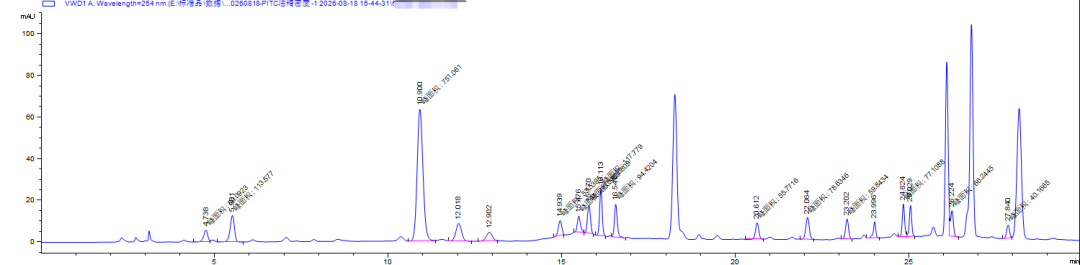
The numbers first. Sample weight: 200.1 mg. Target peak area: 17.2563.
Calibration equation:
y = 2.06917x − 0.53722
R² = 0.9994
Plug the peak area into the equation and the sample solution concentration comes out at 8.5994 μg/mL.
Apply the extraction and dilution factors. The threonine content works out to:
8.5994 × 1 × 1 ÷ 200.1 = 0.043 μg/mg
That is the whole path from HPLC peak area to content value. Real results will vary with the sample, extraction recovery and calibration conditions.
Planning more biochemical measurements? Browse the Solarbio製品カタログ for assay kits and related reagents.
How to Improve Amino Acid HPLC Testing Accuracy
Keep Preparation and Detection Conditions Consistent
A strong peak does not guarantee an accurate result. Extraction conditions shift the response. So do derivatization time, reagent volumes and cleanup steps. Keep every one of them consistent. Standards should follow the exact same derivatization procedure as your test samples.
Peak identity needs attention as well. Especially with amino acids that elute close together.
Low-concentration samples deserve extra care. Assess the detection limit and quantification limit separately. Solarbio’s guide to HPLC LOD and LOQ Validation covers this in detail.
Amino Acid Testing Support from Solarbio
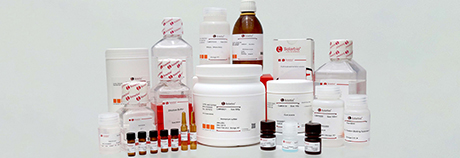
Solarbio supplies analytical standards, derivatization reagents and biochemical assay products for quantitative testing labs.
Need more than standard products? Customized products are available. So is HPLC testing support for projects with special sample or analytical requirements.
For experiment planning that needs extra testing support, review Solarbio’s 技術サービス.
結論
PITC pre-column derivatization does two jobs at once. It makes amino acids detectable with a conventional UV detector. And it helps separate them on the column.
Solarbio’s 22 PITC kits cover the common nutritional, metabolic and research targets. Extraction and derivatization procedures are matched across the series. For labs handling plant, animal, cell and food samples, that makes them a practical option.
Two things matter most: pick the right kit, and keep sample preparation consistent. Do both and the results will hold up.
FAQ
Q1: What is PITC pre-column derivatization in amino acid analysis?
A1: It is a chemical step done before HPLC separation. PITC reacts with amino acids and forms UV-absorbing derivatives. These can be measured at about 254 nm.
Q2: Can the PITC method detect proline?
A2: Yes. PITC reacts with secondary amino groups, and proline has one. The Solarbio BC749H Proline (Pro) Content Assay Kit uses this method for proline quantification.
Q3: What equipment is required for PITC amino acid testing?
A3: You need an HPLC system with UV detection. Sample preparation uses common lab equipment: a centrifuge, vortex mixer, ultrasonic equipment and filtration materials.
Q4: What samples can be tested using Solarbio PITC amino acid assay kits?
A4: The extraction procedures suit many biological materials. Plant tissues, animal samples and cells all work. Food and fermentation samples may also be suitable after proper preparation and method verification.
Q5: How long does PITC derivatization take?
A5: One hour at room temperature under the Solarbio procedure. Keep the time the same for standards and samples. Consistency is what makes quantitative comparison reliable.
Q6: Where can I get information about Solarbio amino acid assay kits?
A6: Solarbioへの問い合わせ to ask about the BC741H–BC764H series. Specifications, availability, customized requirements and technical support are all covered.
 相談
 WhatsApp
 コメント
 トップ