



Related news
Cell Cryopreservation Guide: How to Freeze Cells and Keep Your Backup Culture Safe
Table of Contents
In cell culture, prolonged passaging can induce senescence-associated phenotypic drift, resulting in reduced proliferation rates, altered surface marker expression, and markedly compromised experimental reproducibility. Bacterial, fungal, and stealthy mycoplasma contamination often spread without any visible warning signs. Moreover, unforeseen incidents such as power outages, medium preparation errors, and accidental aspiration or discarding of cultures are frequent and difficult to guard against.
Freezing cells gives the lab a second chance. It keeps early-passage cells available, protects useful cell lines from daily culture risks, and helps researchers repeat experiments with a more stable starting point.
Solarbio provides life science research labs around the world with high-quality reagents, research kits, laboratory consumables, and research tools for cell biology, immunology, molecular biology, and biochemistry. For researchers who need a broader view of products used in cell culture and cryopreservation workflows, please visit the Solarbio product platform.
Why Cell Cryopreservation Is Worth Doing Early
It helps reduce cell aging and phenotype drift
Cells do not stay the same forever. After repeated passaging, some cell lines begin to change. The growth rate may slow down. The shape may look slightly different. Marker expression or response to treatment may also shift. Sometimes the change is small, but it is enough to affect repeatability.
That is why many labs freeze new cell stocks at an early passage. For a newly received cell line, it is usually better to prepare seed stocks within the first 5 passages if the cells are growing well. This gives the lab a cleaner backup before too much handling changes the culture.
For labs building a full research workflow around cell models, the Solarbio solution center can be used as a reference point for reagent selection and related experiment planning.
It protects your work from contamination
Contamination is painful because it often wastes more than one flask. Bacteria and fungi may be easy to see, but mycoplasma can stay hidden for a while. Once contamination spreads, saving the culture is usually not worth the risk.
Frozen stocks do not replace clean handling, but they give you a recovery path. If the active culture is lost, a clean cryovial can restart the work quickly. This is especially important when the cell line is expensive, slow to obtain, or connected to a long project.
It gives the lab a backup when accidents happen
Cell culture work depends on people, equipment, timing, and small daily habits. A power cut, a medium mistake, a missed passage, or a flask left outside the incubator too long can all lead to cell loss.
A good cryopreservation plan keeps important cells outside the daily risk zone. The frozen vial is not just a spare sample. It is the lab’s saved copy.
How to Check Whether Cells Are Ready for Freezing
Use healthy log-phase cells
The best cells for cryopreservation are usually in log-phase growth. For many adherent mammalian cells, around 80–90% confluency is a good working range. The cells should look normal under the microscope, attach or suspend as expected, and grow at a steady rate.
Viability should be above 90% before freezing. If cells are already weak before storage, recovery after thawing will not be good. Freezing does not repair a bad culture. It only preserves the condition you put into the vial.
Cells that are good for freezing are those that have a normal morphology, grow steadily, have a high viability and are not contaminated with bacteria, fungi or mycoplasma. When the culture looks uncertain, it is better to test or passage again instead of rushing into cryostorage.
Researchers working with cell models and downstream assays can browse Solarbio pathway resources when connecting cell culture work with later mechanism studies.
Do not freeze stressed or unstable cells
Some cultures should not be frozen. Over-confluent cells are a common example. When cells are too crowded, they may already enter a plateau phase and stop dividing well. Cells that detach in sheets or float in clumps are also not good candidates.
Newly thawed cells should not be frozen again immediately. They need time to recover. In most routine work, it is safer to passage them one or two times before preparing new frozen stocks.
Over-digested cells are another problem. If trypsin treatment was too long or pipetting was too harsh, the cell condition may already be damaged. Strange morphology, sudden slow growth, and heavy debris should be treated as warning signs.
For cell culture reagents, digestion solutions, and related consumables, labs can use the Solarbio global site to check available product categories and support information.
Choosing the Right Cryopreservation Medium
The real damage comes from ice crystals
Cells are not mainly afraid of cold. The real danger is ice crystal formation during freezing. Large ice crystals can damage cell membranes and internal structures. Once that happens, thawing later cannot fully fix the injury.
Cryopreservation medium helps cells lose water more slowly and reduces ice crystal damage. DMSO is widely used because it can enter cells and protect them during cooling. The problem is that DMSO also has toxicity, so cells should not stay too long at room temperature after it is added.
Common formulas used in labs
For most mammalian cells, a classic freezing medium is 90% FBS plus 10% DMSO. It is simple, familiar, and works for many routine cell lines.
For some immune cells, the serum ratio may be slightly adjusted, such as 92% FBS with 8% DMSO, depending on the lab protocol and cell type.
A more cost-conscious option is 50% FBS, 40% complete medium, and 10% DMSO. This formula may work for stronger cell lines, but recovery can be weaker than the classic serum-rich formula.
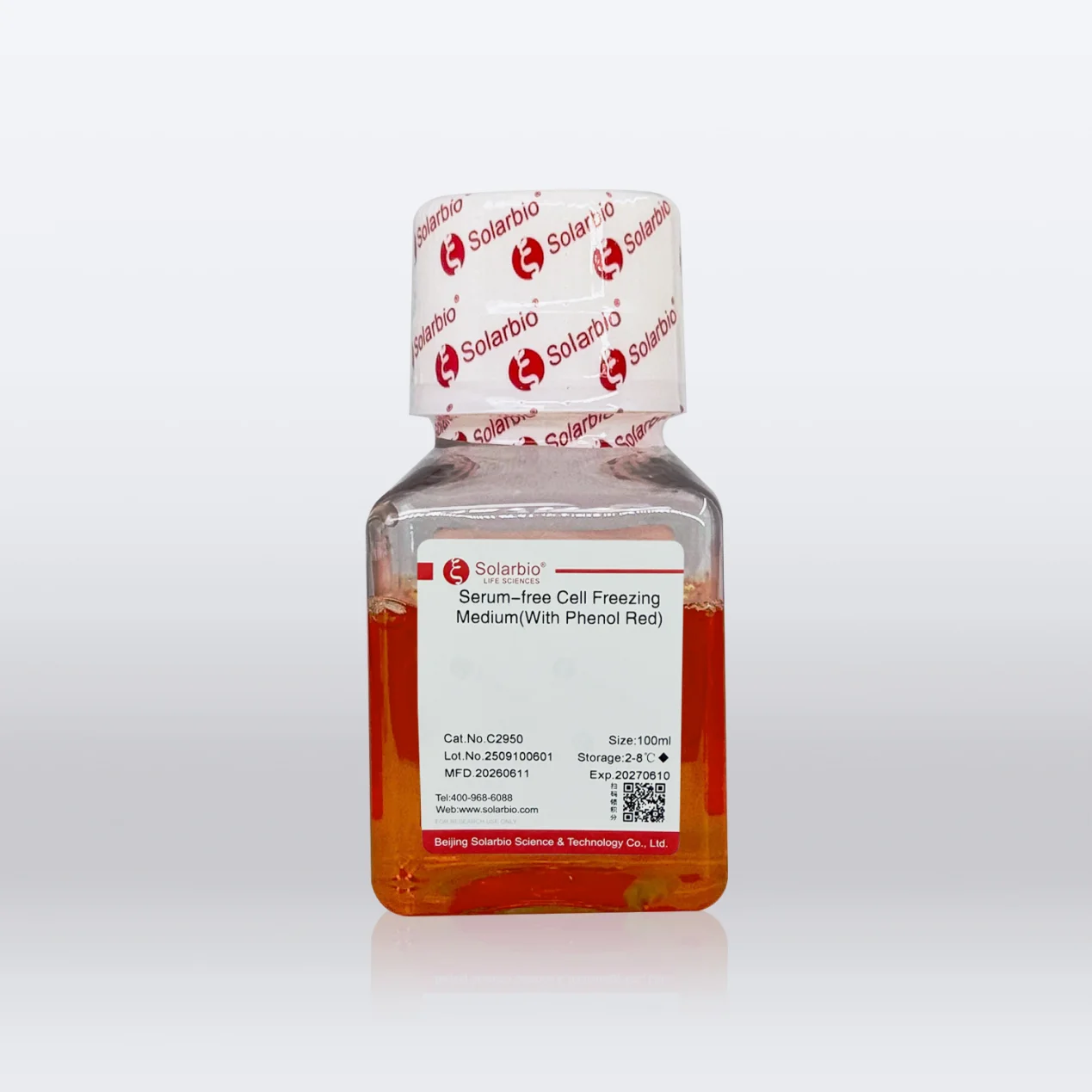
For serum-free culture systems, commercial serum-free cryopreservation medium is often a better choice. It helps reduce serum batch variation and fits labs that want a more defined system. If a team needs help comparing reagent systems or building a repeatable workflow, the Solarbio service page is a useful starting point.
Solarbio Cryopreservation Medium Options for Different Cell Culture Needs
For routine mammalian cell banking, Solarbio Cryopreservation Medium can be used as a ready-to-use alternative to manual FBS/DMSO preparation. For defined serum-free systems, Solarbio Serum-free Cell Freezing Medium (With Phenol Red) helps reduce serum batch variation while keeping visual pH indication. If phenol red may affect imaging or color-based assays, Serum-Free Cell Freeze (Phenol Red Free) is more suitable. For stem cell cultures or DMSO-sensitive workflows, Stem Cell Cryopreservation Medium (Without DMSO) can be considered after recovery validation. For stricter serum-free, phenol-red-free, and DMSO-free requirements, Serum-free Cell Freezing Medium (Without Phenol Red, Without DMSO) is the most targeted option.
Getting Cell Density Right
Too few cells recover slowly
Recovery of cells from frozen stocks is affected by cell density more than most new biologists realize. A very low cell number in a single vial can mean a ‘sparse’ culture that takes a long time to grow back from thawing to full density for experiments. This greatly delays the work.
For most mammalian cells, a common freezing density is 2–5 × 10⁶ cells/mL. The usual freezing volume is 1 mL in a 1.8–2 mL cryovial.
For immune cells, the density is often higher, usually around 5–10 × 10⁶ cells/mL. Suspension cells may need more careful adjustment because recovery depends heavily on starting density and cell condition.
Too many cells are not better
Packing too many cells into one vial is also not ideal. The freezing medium may not protect every cell evenly. DMSO stress may become stronger. The suspension may also become uneven during aliquoting.
Many experienced technicians use a simple habit for routine adherent cells. One T25 flask often goes into one cryovial, and one 10 cm dish often goes into two cryovials. This is not a fixed rule, but it is a practical reference when the cell condition is normal.
For product updates and practical lab content, readers can follow Solarbio news for new application notes and company information.
A Practical Cell Freezing Workflow
Harvest cells gently
Start with healthy log-phase cells. Remove old medium, wash if your protocol requires it, then detach or collect the cells using a method suitable for that cell type.
Handle the cells gently. Hard pipetting does not make the process faster in any useful way. It only adds stress.
After collection, centrifuge under mild conditions. A common setting is 1000–1200 rpm for 5 minutes, though each lab should adjust based on the centrifuge and cell type. After centrifugation, remove the supernatant carefully without disturbing the pellet.
Resuspend and aliquot without delay
Add the prepared freezing medium and resuspend the pellet evenly. Avoid vortexing. Once DMSO has touched the cells, do not leave the suspension sitting at room temperature for long.
Aliquot the suspension into labelled cryovials, usually 1 mL per vial. If using a commercial cryopreservation reagent, follow the product instructions instead of mixing different habits from different protocols.
Clear labelling matters. Each vial should show the cell line name, passage number, freezing date, and operator or project code. A useful cell stock can become useless if nobody can identify it later.
For company background, quality system information, and product scope, readers can visit the Solarbio about page.
Cooling and Long-Term Storage
Controlled cooling is safer
The ideal cooling speed is about -1°C per minute until the samples reach -80°C. Many labs use an isopropanol freezing container or a controlled-rate freezing box for this step. It is simple and reliable enough for routine cell culture.
Some labs use stepwise cooling, moving samples from 4°C to -20°C, then to -80°C overnight. This can work, but it depends more on timing and operator habits.
Direct transfer to -80°C is only suitable when the commercial cryopreservation medium clearly says this method is acceptable. If the medium is not designed for direct freezing, cell viability may drop badly.
Liquid nitrogen is for long-term storage
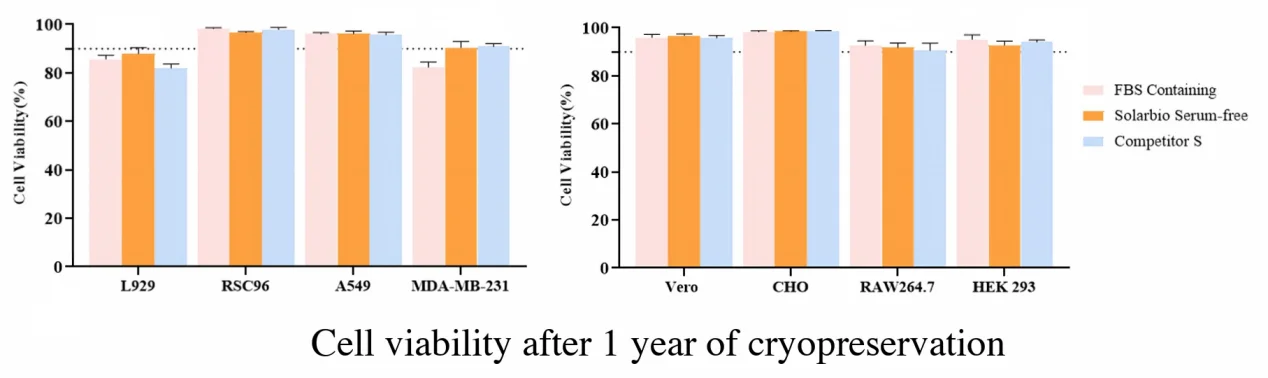
-80°C is usually a transition step, not the best place for long-term storage of valuable cells. After overnight cooling, cryovials should be moved into liquid nitrogen for stable storage.
Vapor-phase liquid nitrogen storage is often used to reduce contamination risk while keeping the temperature very low. For important cell banks, storage records should be checked regularly.
If a lab needs help with reagent selection, documentation, or technical communication, the Solarbio contact page can be used to reach the team.
What to Watch After Thawing
Low viability usually starts before freezing
When cells recover poorly after thawing, the problem is not always the thawing step. Many issues begin before freezing. The original culture may have been too old, too crowded, contaminated, over-digested, or exposed to DMSO too long.
Fast thawing is usually preferred. Warm the vial quickly in a 37°C water bath until only a small ice crystal remains, then transfer the cells into pre-warmed medium. Sensitive cells may need DMSO removal by centrifugation after dilution.
Give cells time to recover
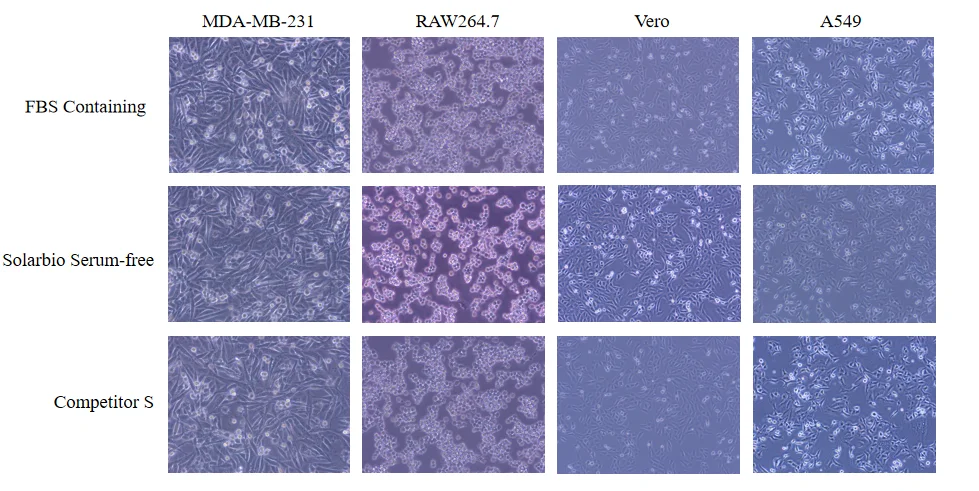
Freshly thawed cells may grow slowly at first. That does not always mean failure. Many cells need 24–72 hours to recover from freezing stress.
Do not rush directly into formal experiments unless the protocol already allows it. When possible, passage the cells once or twice before collecting key data.
Conclusion
Cell cryopreservation is not a complicated idea, but the small details matter. Healthy cells, suitable freezing medium, correct density, fast handling after DMSO addition, controlled cooling, and liquid nitrogen storage all affect recovery.
For routine labs, frozen stocks save time and money. For long-term research, they protect repeatability. For teams handling valuable or hard-to-replace cell lines, they are part of the experimental plan, not an afterthought.
Solarbio provides life science research tools across cell biology, immunology, molecular biology, and biochemistry. When building a more stable cell culture workflow, it is worth checking Solarbio’s linked product and service resources before the next cell bank is prepared.
FAQ
Q1: What is the best time to freeze cells?
A1: The best time is when cells are in log-phase growth. For many adherent mammalian cells, around 80–90% confluency is a good range.
Q2: What viability is recommended before freezing cells?
A2: Viability should usually be above 90%. Weak cells before freezing usually recover poorly after thawing.
Q3: Can newly thawed cells be frozen again right away?
A3: It is better not to do that. Newly thawed cells should recover and pass one or two times before another freezing step.
Q4: Why is DMSO used in freezing medium?
A4: DMSO helps reduce ice crystal damage during freezing. It protects cells during cooling, but long exposure at room temperature can harm cells.
Q5: What is the common freezing medium formula for mammalian cells?
A5: A common formula is 90% FBS plus 10% DMSO. Some labs use 50% FBS, 40% complete medium, and 10% DMSO for stronger cell lines.
Q6: What density should be used for cell freezing?
A6: Most mammalian cells are often frozen at 2–5 × 10⁶ cells/mL. Immune cells may need 5–10 × 10⁶ cells/mL.
Q7: Is direct freezing at -80°C acceptable?
A7: It is acceptable only when the cryopreservation medium clearly supports that method. Otherwise, controlled cooling is safer.
Q8: How long should cells stay at -80°C before liquid nitrogen storage?
A8: Many labs keep vials at -80°C overnight after controlled cooling, then transfer them to liquid nitrogen the next day.
Q9: Why do cells grow slowly after thawing?
A9: Slow growth can come from poor starting condition, low freezing density, DMSO stress, unstable cooling, or normal recovery delay in sensitive cells.
Q10: What should be written on a cryovial label?
A10: The label should include the cell line name, passage number, freezing date, and operator or project code. Clear labels prevent sample confusion later.
 Consult
 Whatsapp
 Leave Message
 top
top