




Related news
How to Choose the Right Cell Freezing Medium for Better Cell Recovery
Sep. 03, 2026
195
Table of Contents
Preserving cells in fixed states appears to be a rather trivial laboratory task. It’s very frustrating when a very valuable culture does not recover from long term storage. At first the thawed cells look okay in the medium that has thawed with them. Later they will slowly attach to the bottom of the dish, start to divide but unevenly, or not at all. Most people will blame the LN2 tank or the way that the cells were thawed. But often the cause of all problems lies much further back.
Cell condition before freezing, the cryoprotective system, exposure to DMSO, freezing density, and the freezing medium itself all affect what happens after thawing.
That is why cell freezing medium should not be treated as an afterthought. A good formulation needs to protect the cells during cooling without creating another source of stress. Solarbio supplies cell biology reagents and related culture products through its wider Solarbio product range, including different cryopreservation formulations for routine cell lines, sensitive cells, immune cells, stem cells, and other research models.
Why Does Cell Freezing Medium Matter So Much?
Freezing Damage Starts Before the Cells Reach Liquid Nitrogen
Cells are not damaged simply because they become cold. A major problem is ice formation.
Crystals can form inside the cells and in the intercellular space. These can cause severe damage to the membranes and the internal structures of the cells. During cooling, the cells are subjected to osmotic stress. Water is moving into and out of the cells. The surrounding extracellular solution becomes more and more concentrated.
A cryopreservation medium is designed to reduce these stresses. It gives cells a better chance of surviving both freezing and thawing.
Researchers who want a broader look at the complete freezing process can also read the Cell Cryopreservation Guide: How to Freeze Cells and Keep Your Backup Culture Safe, which covers cell condition, freezing density, cooling, storage, and post-thaw recovery.
DMSO Is Useful, but It Needs Careful Handling
DMSO is one of the most common cryoprotectants in cell culture. Solarbio DMSO (Dimethyl Sulfoxide) (Cell Culture Grade) is commonly used in cell culture applications and can enter cells to reduce damaging ice formation during cooling. That is why many classic freezing formulas contain DMSO.
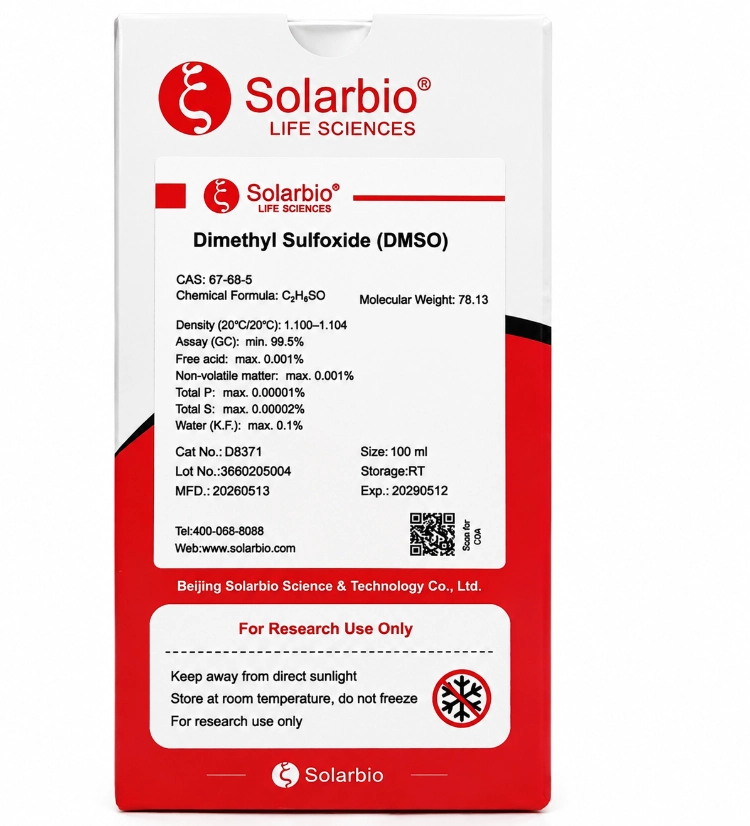
The useful part and the troublesome part come together. DMSO can protect cells at low temperature, but prolonged exposure at room temperature may reduce cell viability. Once a DMSO-containing freezing medium is mixed with the cell suspension, handling should not drag on unnecessarily.
If you prefer a ready-to-use, routine formulation, Solarbio Cryopreservation Medium can be used as a component of a typical mammalian cell banking procedure.
Should You Choose Serum-Containing or Serum-Free Freezing Medium?
Serum-Containing Formulas Are Familiar but Less Defined
A serum-containing freezing medium is still widely used. The familiar combination of serum and DMSO works with many established mammalian cell lines and has been used in laboratories for years.
The main limitation of this system is batch-to-batch variability.
Serum contains proteins, hormones, growth factors, lipids, and many other biological components. Their levels can differ between sources and lots. A cell line that recovers well with one lot may behave differently after the laboratory changes to another.
There are also projects where animal-derived components are simply not wanted. Stem cell research, cell therapy-related work, sensitive immune cell studies, and more controlled culture systems often benefit from a more defined freezing environment.
Serum-Free Media Make the System Easier to Control
A serum-free freezing medium removes serum-related variability from the process. That makes it easier to standardize a cell banking protocol across different batches and operators.
It also saves time. There is no need to prepare a serum/DMSO mixture every time cells are frozen. A ready-to-use medium can reduce small preparation errors that are easy to make during a busy culture day.
For researchers who still want DMSO in the formulation while removing serum, Serum-free Cell Freezing Medium (With Phenol Red) provides a defined option with a visible pH indicator.
This kind of formulation can fit routine cell culture where serum variation is a concern but DMSO cryoprotection is still acceptable.
Does Phenol Red Matter in a Cryopreservation Medium?
Phenol Red Can Be Useful for Routine Handling
Phenol red is familiar to anyone who works with cell culture media. It gives a quick visual indication of changes in the medium environment.
For basic freezing and recovery work, that can be convenient. It does not replace proper pH control, but it gives the operator an immediate visual reference during routine handling.
The choice becomes different when downstream detection is sensitive to background color.
Phenol-Red-Free Formulas Fit Some Detection Work Better
If the recovered cells will be used for fluorescence imaging, color-based measurements, or another assay where background interference matters, a phenol-red-free system may be preferred.
Solarbio Serum-Free Cell Freeze (Phenol Red Free) is designed for this type of requirement while keeping the freezing system serum-free.
The important point is not to choose phenol red or no phenol red because one sounds more advanced. Match it to the work that comes after thawing. A standard cell expansion experiment and a sensitive optical assay do not always need the same formulation.
When Does DMSO-Free Cell Cryopreservation Make Sense?
Some Cells and Workflows Need a Different Cryoprotective System
DMSO is widely used, but that does not mean every cell model should automatically use it.
Some sensitive cells recover poorly after DMSO exposure. In other projects, researchers want to reduce the amount of residual DMSO carried into downstream culture. This can matter in stem cell work, immune cell applications, or research where post-thaw cellular function is more important than simply counting surviving cells.
A DMSO-free medium uses another protective formulation instead of relying on the standard DMSO system. The final choice still needs to be tested with the actual cell type because “DMSO-free” does not automatically mean “better for every cell.”
For stem cell workflows where DMSO avoidance is a real requirement, Stem Cell Cryopreservation Medium (Without DMSO) is one option that can be evaluated through a small recovery test before larger cell banks are prepared.
Sensitive Cells Should Be Judged by Recovery Quality, Not One Number
Post-thaw viability is useful, but it is not the whole story.
A cell population may show a high viability reading immediately after thawing and still grow poorly over the next two days. Stem cells may survive but lose the characteristics needed for later differentiation. Immune cells may remain alive while showing weaker functional responses.
That is why recovery should be checked through cell morphology, attachment or suspension behavior, proliferation, and the main functional marker used in the project.
Cell identity and passage history matter as well. The previously published Cell Lines: The First Step Behind Reliable In Vitro Research explains why early seed stocks, passage control, cell identity, and mycoplasma status are closely tied to repeatable in vitro work.
How Should You Choose a Freezing Medium for Different Cells?
Routine Cell Lines Usually Need Simplicity and Repeatability
For the most commonly used cell lines like A549, CHO, Jurkat and many others which are frequently used in research, the main requirement is recovery of the cells and simplicity of freezing process.
A ready-to-use medium can make sense when many operators share the same cell bank. Everybody follows the same formula, so the result depends less on who prepared the freezing solution that day.
The original condition of the cells still matters. Healthy log-phase cells usually freeze better than overgrown, contaminated, or heavily stressed cultures. A good medium cannot repair a poor starting culture.
Stem Cells and Immune Cells Need More Attention
iPSC, other stem cells, PBMC, NK cells, αβ-T cells, γδ-T cells, and related immune cell models are often less forgiving.
The question is not only whether the cells survive. Researchers may need to preserve stemness, differentiation potential, surface markers, cytokine response, expansion ability, or other functional properties.
That is where cell-specific or application-specific freezing media become useful. Solarbio offers different formulations covering routine, serum-free, DMSO-containing, DMSO-free, and specialized cell cryopreservation needs.
When the model is unusual or several formulations could work, a small comparison is cheaper than discovering a problem after a large cell bank has already been frozen. Researchers can use Solarbio technical service for product selection and application support when matching a cryopreservation system to a specific cell model.
Conclusion
A good cell freezing medium does more than keep cells alive in storage. It helps preserve a usable starting point for the next experiment.
Serum-containing formulas remain practical for many routine cell lines. Serum-free media reduce serum-related variability and make preparation more consistent. Phenol-red-free products suit workflows where background color is unwanted. DMSO-free formulations give laboratories another option for sensitive cells or projects where DMSO exposure needs to be reduced.
No single freezing medium is the best choice for every cell.
Start with the cell type and the downstream experiment. Check the condition of the culture before freezing. Keep DMSO exposure controlled when DMSO is present. Then judge the result after thawing by more than immediate viability alone.
When the right medium and good cell handling are used together, frozen stocks become what they are supposed to be: a dependable backup instead of another source of uncertainty.
FAQ
Q1: What is the main purpose of cell freezing medium?
A1: Cell freezing medium protects cells from ice crystal formation, osmotic stress, and other damage during cooling and frozen storage. Its purpose is to improve survival and functional recovery after thawing.
Q2: Is serum-free cell freezing medium better than serum-containing medium?
A2: Not in every case. Serum-free media offer a more defined formulation and reduce serum lot variation. Serum-containing formulas can still work well for many routine cell lines. The best choice depends on the cell model and the required downstream application.
Q3: Why is DMSO used in cell cryopreservation?
A3: DMSO acts as a cryoprotectant. It enters cells and helps reduce damaging ice crystal formation during cooling. Since DMSO can also affect cell viability during prolonged exposure at warmer temperatures, cell handling should be efficient after it is added.
Q4: When should I consider a DMSO-free freezing medium?
A4: A DMSO-free formulation may be useful for DMSO-sensitive cells, stem cell research, immune cell workflows, or experiments where residual DMSO may affect later applications. Recovery should still be validated with the actual cell type.
Q5: Does phenol red affect cell freezing?
A5: Phenol red is mainly a pH indicator rather than the main cryoprotective component. A phenol-red-free formulation may be preferred when recovered cells will be used in color-sensitive or fluorescence-based assays.
Q6: Can the same freezing medium be used for iPSC, PBMC, NK cells, and common cell lines?
A6: Some general formulations may work across several cell types, but sensitive cells often need more specific conditions. iPSC, PBMC, NK cells, T cells, and other specialized models should be tested for post-thaw viability and function before a large cell bank is prepared.
Q7: Why can cells still recover poorly even when a good freezing medium is used?
A7: The problem may start before freezing. Over-confluent cells, contamination, low pre-freezing viability, excessive digestion, unsuitable cell density, prolonged DMSO exposure, poor cooling control, or incorrect thawing can all reduce recovery.
Q8: What should be checked after cells are thawed?
A8: Check immediate viability, morphology, attachment or suspension behavior, proliferation, and any important functional marker. Sensitive cells may need 24 to 72 hours before their true recovery condition becomes clear.
 Consult
 Whatsapp
 Leave Message
 top
top