


Trypsin Inhibitor Activity Assay: A Simple Spectrophotometric Method
Table of Contents
Trypsin inhibitor activity is easy to mention, but not always easy to measure well. A clear looking soybean extract can still contain high amounts of active inhibitor. A plant sample can express high levels of defense-related proteins but this does not translate into actual trypsin activity blocked.
This is why an activity assay is useful. This test measures the effect of an inhibitor protein on trypsin. Instead of measuring the amount of inhibitor protein, the effect on trypsin is measured. The color reaction is read out using a spectrophotometer or a microplate reader at 405 nm.
The method is practical for food samples, plant tissue, feed materials, purified proteins, and other research samples. Laboratories that need to combine this test with other enzyme or protein measurements can also check Solarbio’s life science research solutions for related products and workflow support.
What Is a Trypsin Inhibitor?
A trypsin inhibitor is a protein/peptide which can bind to trypsin to decrease its enzyme activity. Trypsin inhibitors occur in plants, animals and in microorganisms.
Trypsin is a serine protease which can split large dietary proteins into smaller peptides. In animals trypsin is produced by the pancreas as trypsinogen, the inactive precursor. Trypsinogen is activated to trypsin in the small intestine of animals.
That activation step matters. The trypsin in our digestive systems is very useful, but if this enzyme were to become active in tissues elsewhere in the body it would cause damage to those tissues. This is naturally inhibited by other proteins.
In plants, trypsin inhibitors are defense proteins that, for example, can interfere with the digestive enzymes of insects and other organisms that are fed by the plant. Thus the same type of molecule can be studied in the framework of digestive physiology, of food processing, of plant protection and of protein regulation.
Kunitz-Type Trypsin Inhibitors
Kunitz-type trypsin inhibitors are bigger proteins. They have a molecular weight of 18-24 kDa. These inhibitors typically have one reactive site and 2-3 sets of disulfide bonds.
Many proteinase inhibitors form a 1:1 complex with one trypsin molecule. The complex between an inhibitor and an enzyme is very stable. The enzyme in such a complex loses a large part of its catalytic activity.
Bovine pancreatic trypsin inhibitor, also called BPTI or aprotinin, is a common example. Several proteinase inhibitors isolated from potato also belong to the Kunitz family.
In food and feed research these proteins are studied after heat treatment. Although the amount of inhibitor protein is still present after processing, the activity can drop sharply. Therefore an activity test is more suitable than a total protein determination.
Bowman-Birk Trypsin Inhibitors
Bowman-Birk inhibitors are smaller, often around 6 to 10 kDa. Their structure is compact and usually contains seven pairs of disulfide bonds.
One useful feature is that they can have two separate reactive sites. One site may inhibit trypsin, while the other inhibits chymotrypsin. This gives them a wider inhibitory range than many single-site inhibitors.
They are found in soybean, pumpkin, mung bean, red bean, sunflower, buckwheat, and other plant materials. Their stable structure has drawn attention in both food science and functional ingredient research.
Why Do Laboratories Measure Trypsin Inhibitor Activity?
The same test can answer very different questions. A food processor may want to know whether heating has reduced antinutritional activity. A plant researcher may want to compare insect resistance between samples. A protein laboratory may be checking the activity of a purified inhibitor batch.
The test method stays similar, but the way the result is read depends on the project.
Food and Feed Processing
Raw soybean and other legumes may contain a noticeable amount of active trypsin inhibitor. When these materials are eaten without enough heat treatment, protein digestion can become less efficient.
The body may respond by producing more digestive enzymes. In long-term feeding studies, high inhibitor intake has also been linked with changes in pancreatic activity.
Heating lowers inhibitor activity, but more heat is not always better. If the treatment is too weak, too much active inhibitor remains. If it is too strong, useful proteins may be damaged and nutritional quality may fall.
A trypsin inhibitor activity assay helps processors check that balance. It gives a direct result on the inhibitor that is still active after processing.
Solarbio supplies a wider range of biochemical assay kits for laboratories that need to measure enzyme activity, metabolites, oxidative stress markers, or related sample properties in the same project.
Plant Defense Studies
Plants can increase trypsin inhibitor production after insect feeding or pathogen attack. The inhibitor enters the digestive system of the feeding insect and blocks part of its protease activity.
This does not always kill the insect directly. More often, it makes digestion less efficient. Growth may slow, feeding may change, and development may be delayed.
Researchers may compare inhibitor activity between plant varieties, treatment groups, or stress conditions. Gene expression data can show whether an inhibitor gene is being turned on. The activity assay shows whether the produced protein is still functional.
For projects that connect inhibitor activity with stress signaling or metabolic changes, Solarbio’s pathway research resources can help with the selection of related compounds, antibodies, and assay products.
Protease Control in Biological Models
Trypsin inhibitors also have a protective role in animal systems. SPINK1 is one example. It limits premature activation of trypsin inside the pancreas.
When this control fails, pancreatic tissue may be exposed to active digestive enzymes. That is one reason trypsin regulation is often discussed in pancreatitis research.
Aprotinin and other protease inhibitors have also been studied in inflammation, ischemia, edema, and other models. These projects usually need more than one readout. A lower enzyme signal may show inhibition, but it does not explain every downstream biological change.
How Does the Spectrophotometric Method Work?
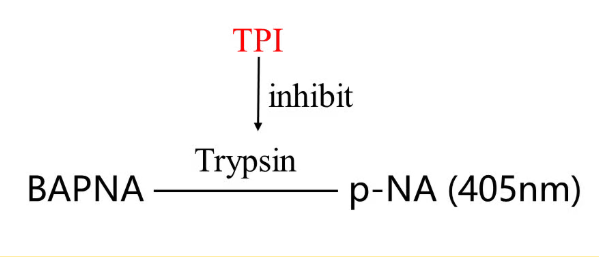
The basic chemistry is not complicated. Trypsin reacts with a chromogenic substrate. The reaction releases a yellow product. When an inhibitor blocks trypsin, less yellow product is formed.
The Solarbio BC6860/BC6865 Trypsin Inhibitor Activity Assay Kit is based on this principle.
BAPNA as the Chromogenic Substrate
BAPNA is used as the substrate for trypsin. When trypsin hydrolyzes BAPNA, p-nitroaniline is released.
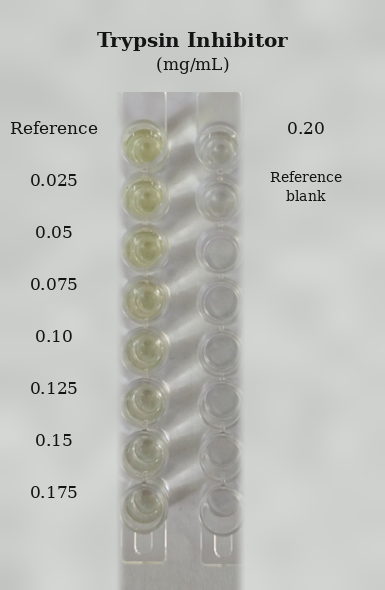
P-nitroaniline, often written as p-NA, has a yellow color and can be measured at 405 nm. More active trypsin produces more p-NA, so the absorbance becomes higher.
When a sample contains a trypsin inhibitor, part of the enzyme is blocked. Less BAPNA is hydrolyzed. The amount of p-NA falls, and the absorbance reading becomes lower.
The assay therefore measures remaining trypsin activity after contact with the sample. It does not stain or measure the inhibitor directly.
What Does a Lower Reading Mean?
A lower absorbance usually means stronger inhibition, provided that the blank and control reactions are correct.
A weak inhibitor leaves most of the trypsin active. The reaction stays yellow and gives a higher reading. A strong inhibitor blocks more enzyme, so less yellow product appears.
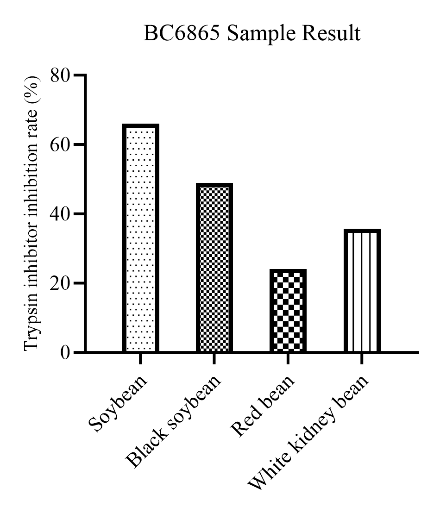
The final calculation compares the sample reaction with the required controls. Results may be reported as inhibitor activity, inhibition units, or activity normalized to sample weight or protein content.
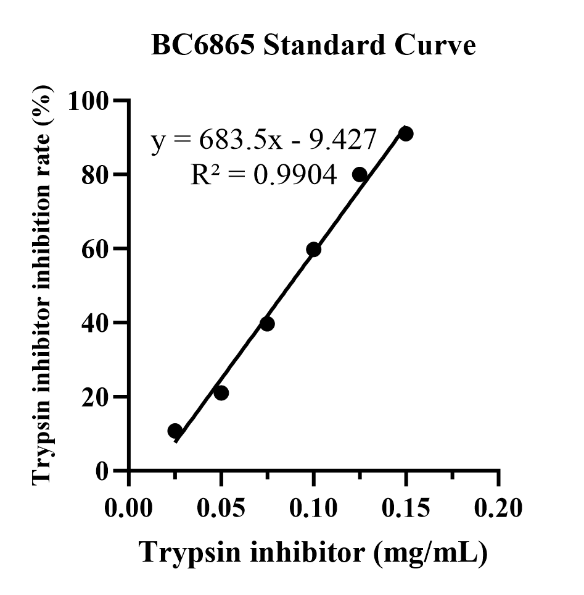
Samples outside the recommended measurement range should be diluted and tested again. Using an absorbance value outside the linear range can make a neat-looking calculation that is not reliable.
What Usually Causes Poor Repeatability?
Most problems do not come from the idea behind the test. They come from sample handling.
Uneven Sample Extraction
Plant and food samples need to be ground well. A coarse or uneven sample may release different amounts of inhibitor from one portion to another.
The sample weight, extraction volume, mixing time, extraction temperature, and centrifugation conditions should remain the same between groups. Changing one of these halfway through a batch can affect the result.
Dark or cloudy extracts may add background absorbance. A sample blank is useful here. Without it, the natural color of the sample may be mistaken for reaction product.
Timing Differences Between Wells
Enzyme reactions continue while the plate or tube is being handled. If the first sample receives the substrate several minutes before the last one, the difference may show up in the final absorbance.
For a larger plate, a multichannel pipette usually makes the timing easier to control. For tube-based work, it may be better to run smaller groups instead of starting every sample at once.
Temperature matters too. Trypsin activity can change when reagents sit on the bench for too long or when reaction tubes are not kept under the same conditions.
Laboratories working with unusual sample types can ask Solarbio’s technical service team about extraction, dilution, and assay setup.
Missing Controls
A sample tube alone is not enough. The test needs controls for enzyme activity, substrate background, sample color, and other non-enzymatic changes in absorbance.
It is tempting to remove a control to save wells, especially when the plate is nearly full. That usually causes trouble later. A result is much harder to explain when the background contribution is unknown.
Technical replicates should also be included. When replicate values are far apart, the first place to check is pipetting, mixing, timing, and sample clarity.
Which Related Assays Can Be Used Alongside This Test?
Trypsin inhibitor activity is often only one part of the work.
The BC2310/BC2315 Trypsin Activity Assay Kit can be useful when the project needs to measure trypsin itself. Running enzyme activity and inhibitor activity side by side helps separate two different situations: low trypsin activity and strong inhibition of normal trypsin activity.
Other related products include BC1020/BC1025 Xanthine Oxidase Inhibitor Activity Assay Kit, BC6380/BC6385 α-Glucosidase Inhibitor Activity Assay Kit, and BC6450/BC6455 β-Galactosidase Inhibitor Activity Assay Kit.
These assays are useful in screening work where several enzyme inhibitors are being compared under the same sample or extraction conditions. Solarbio also shares product updates and application information through its research news section.
Why Use Solarbio for This Type of Assay?
Solarbio has supplied life science research products since 2004. Its product range includes biochemical assay kits, antibodies, ELISA kits, cell biology reagents, staining products, analytical standards, molecular building blocks, and small molecule compounds.
The company works under ISO 13485, ISO 9001, ISO 14001, and ISO 45001 management systems. Its testing center has CNAS accreditation. Further details about the company, product development, and quality system are available on the About Solarbio page.
For a routine enzyme assay, the useful things are quite basic: stable reagents, a clear protocol, workable controls, and someone who can answer when the sample does not behave as expected. That is what usually decides whether the second run matches the first.
Conclusion
The trypsin inhibitor activity assay measures how much a sample blocks trypsin. Trypsin hydrolyzes BAPNA and releases yellow p-NA. Stronger inhibition means less p-NA, so the absorbance at 405 nm becomes lower.
The method can be used for soybean, legumes, plant tissue, food, feed, purified inhibitor preparations, and biological samples. Sample preparation and timing need attention. So do the blank and control reactions.
The BC6860/BC6865 Trypsin Inhibitor Activity Assay Kit gives laboratories a simple spectrophotometric option for this work. Researchers who are unsure about sample compatibility, extraction conditions, or related products can contact Solarbio before setting up the first run.
FAQ
Q1: What does a trypsin inhibitor activity assay measure?
A1: It measures the ability of a sample to reduce trypsin activity. The result reflects functional inhibition rather than the total amount of inhibitor protein.
Q2: Why is BAPNA used in the test?
A2: BAPNA is a chromogenic substrate for trypsin. Trypsin hydrolyzes it and releases yellow p-nitroaniline, which can be measured at 405 nm.
Q3: Does lower absorbance mean stronger inhibition?
A3: Yes. When more trypsin is inhibited, less BAPNA is hydrolyzed and less p-nitroaniline is produced. The absorbance therefore becomes lower.
Q4: Can soybean and other legumes be tested?
A4: Yes. Soybean, mung bean, red bean, and other plant materials can be tested after proper extraction. Colored or cloudy samples should include a suitable sample blank.
Q5: Why are the replicate readings different?
A5: Common reasons include uneven grinding, pipetting errors, different reaction times, temperature changes, poor mixing, sample turbidity, or incorrect blank settings.
Q6: Is trypsin inhibitor activity the same as trypsin activity?
A6: No. Trypsin activity measures how well the enzyme breaks down its substrate. Trypsin inhibitor activity measures how strongly a sample reduces that enzyme activity.
 Consult
 Whatsapp
 Leave Message
 top
top